
Introduction: The Challenge of Fragmented Data
Imagine trying to make critical business decisions when your data is scattered across ERP systems, data warehouses, and cloud apps. Sales, finance, and operations each cling to different “sources of truth,” making it nearly impossible to get a unified view of the company.
This fragmented landscape is the reality for many enterprises – SAP ECC or S/4HANA transactional data in one silo, an aging SAP BW in another, and various departmental databases elsewhere [pcg.io]. The result? Data silos and inconsistencies.

Teams lack a 360° view of the business, duplicate efforts maintaining parallel data sets, and often question which numbers to trust[pcg.io]. Traditional approaches to analytics forced organizations to extract SAP data into external warehouses or data lakes, a process that is costly, slow, and prone to errors. Maintaining complex ETL pipelines and custom integrations not only drives up IT costs, but it also strips away the rich business context inherent in SAP data – context that AI and analytics desperately need for accurate insights.
Enter SAP Business Data Cloud (BDC). Announced in early 2024 as a key pillar of SAP’s data strategy [pcg.io], this fully-managed SaaS solution is designed to end the data fragmentation. SAP Business Data Cloud brings together your mission-critical SAP data and third-party data in one place, with governance and business context intact [sap.com]. It follows SAP’s business data fabric strategy, blending data management, analytics, and AI.
In this post, we’ll explore how SAP Business Data Cloud works, how it compares to traditional solutions, and what unique benefits it offers to IT leaders and business users alike.
Traditional Data Management vs. SAP Business Data Cloud
To appreciate BDC’s value, it helps to contrast it with the status quo. Historically, organizations running SAP faced tough choices in pursuing advanced analytics or AI. They either extended legacy on-premises systems (like SAP BW) with costly upgrades, or exported data out of SAP into separate platforms (data lakes, third-party BI tools), sacrificing integration and governance. Let’s compare the old approach with the new SAP Business Data Cloud approach:

As the comparison shows, SAP Business Data Cloud breaks with tradition by eliminating data duplication, preserving business meaning, and offering a unified analytics environment. In essence, SAP is moving from a world of disconnected tools to an integrated data and analytics platform.
This platform-centric approach is similar in spirit to modern data stacks like Microsoft Fabric – with an important difference: BDC’s DNA is unmistakably SAP. It’s built for enterprises that live on SAP processes and need analytics deeply connected to those processes [arpideas.com]. (In fact, SAP has even partnered with Microsoft and others so that BDC can coexist and share data with non-SAP ecosystems. For example, BDC Connect for Databricks and Microsoft Fabric enables bi-directional, zero-copy data sharing between SAP and those platforms[databricks.com], reflecting SAP’s commitment to openness.)
Inside the SAP Business Data Cloud
So, what exactly is inside SAP Business Data Cloud, and how does it deliver these benefits? In simple terms, BDC is a bundle of powerful data services woven together on SAP’s cloud platform. It builds on existing SAP technology (like SAP Datasphere and SAP Analytics Cloud) and adds new capabilities to create a seamless end-to-end solution [pcg.io]. Let’s unpack its architecture and key features:
1. Architecture Built for Integration & Intelligence
BDC runs on SAP HANA Cloud and includes HANA Data Lake for scalable storage. It combines:
- SAP Datasphere for modeling, integration, semantics
- SAP Analytics Cloud for BI and planning
- Databricks (embedded in BDC) for machine learning
- SAP BW/4HANA (optional) for customers modernizing BW
BDC works in multicloud and hybrid environments. It connects to S/4HANA, SuccessFactors, Snowflake, BigQuery, and many more tools.
2. Data Products: Modern Single Source of Truth
A data product packages curated data with:
- business definitions
- logic
- governance rules
- semantic context
Examples include profitability models, supply chain KPIs, or cost allocation logic.
SAP offers pre-built data products, and customers can convert BW models into data products through SAP’s generators.
3. Insight Apps: Ready-to-Use Analytics
Insight Apps are pre-built dashboards and planning scenarios for common business needs such as:
- working capital
- procurement
- cost control
- supply chain performance
These apps run on trusted data products, so business teams get immediate insights with minimal setup.
4. Modernizing BW Without Disruption
BDC is ideal for customers still using BW 7.5 or BW/4HANA. Instead of rebuilding everything:
- Move BW to Private Cloud Edition
- Keep logic through 2030
- Convert BW models into data products
- Transition gradually without risking operations
More details here: BW to BDC Migration Guide
5. Open Architecture for the Modern Data Stack
BDC integrates with:
- Databricks (via Delta Sharing)
- Microsoft Fabric
- Snowflake
- BigQuery
- Python notebooks
This allows SAP data to flow into external lakehouses with business context preserved—no heavy ETL required.
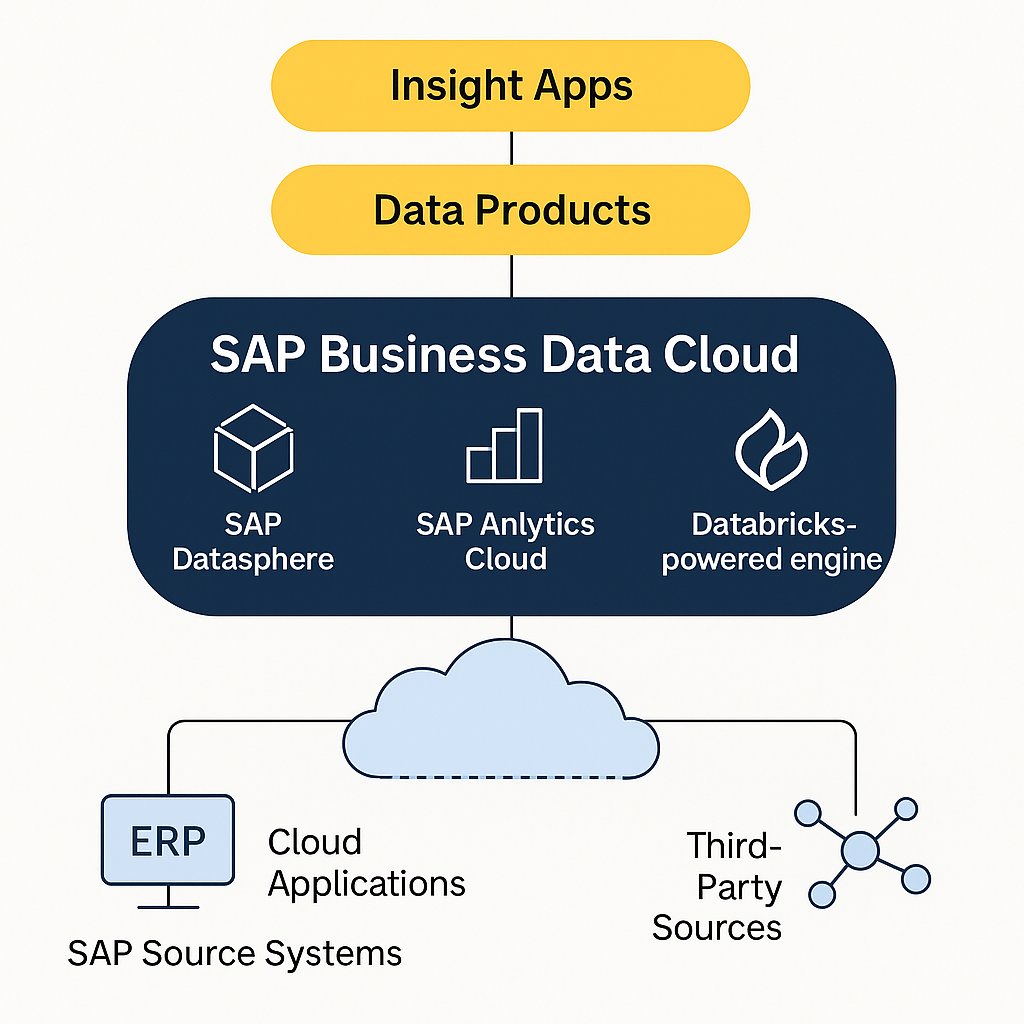
Figure: High-level architecture of SAP Business Data Cloud. It shows how SAP’s “business data fabric” unifies data from both SAP source systems (ERP, cloud applications) and third-party sources into a single cloud platform. Key components like SAP Datasphere (for data modeling and integration), SAP Analytics Cloud (for BI and planning), SAP’s Databricks-powered engine (for data science and AI/ML), and SAP BW (optional) work together to manage and enrich data. On top of this foundation, Data Products (trusted, reusable datasets with business context) are created and used by AI-driven Insight Apps (prebuilt analytics applications) to deliver intelligent insights across all lines of business.
Business Benefits of SAP Business Data Cloud
Faster, More Confident Decisions
Henkel used BDC with Databricks to build trusted AI-ready datasets. ZEISS integrated real-time systems using HANA Cloud and Datasphere for faster insights.
Lower Total Cost of Ownership
BDC consolidates data lake, integration, warehouse, BI, planning, and AI into one subscription.
Cold data uses low-cost storage instead of expensive in-memory storage.
AI Made Simple
Databricks notebooks and SAP AI services run directly on SAP data with full governance, enabling faster experimentation and deployment.
Conclusion: Is SAP Business Data Cloud Right for You?
In an era where data-driven insight and AI agility can make or break competitive advantage, SAP Business Data Cloud emerges as a compelling solution for enterprises anchored in the SAP ecosystem. By unifying data, preserving business context, and embracing an open architecture, BDC addresses the age-old pain points of data silos and slow analytics. It offers IT leaders a path to modernize analytics architecture (with minimal disruption) and gives business users faster access to insights powered by trusted data. The tone is set for a new way of thinking: instead of seeing analytics as a separate silo or an afterthought, SAP is embedding analytics and AI into the very fabric of business processes via BDC.
For SAP consultants and data analysts, BDC represents an exciting opportunity to deliver value faster – using prebuilt content where appropriate and focusing effort on truly unique business problems rather than plumbing. For business executives and IT decision-makers, the platform provides confidence that data (from finance, supply chain, HR and beyond) is consistent and ready to fuel advanced analytics or AI initiatives safely. Of course, every organization’s landscape is different. Some may leverage BDC alongside other platforms (indeed, large enterprises might use both SAP BDC and something like Microsoft Fabric in parallel for different needs [arpideas.com]). What’s clear is that SAP is positioning Business Data Cloud not just as a technology, but as a strategic enabler – a bridge between transactional business operations and the world of AI-driven insight.
Call to Action: If your company runs on SAP and you’ve felt the frustrations of fragmented data or sluggish analytics projects, it may be time to take a closer look at SAP Business Data Cloud. Consider how a unified, context-rich data foundation could accelerate your journey to becoming a truly data-driven, intelligent enterprise. Feel free to reach out or comment with your thoughts and experiences – how do you see a solution like BDC fitting into your data strategy? And if you’re ready to explore it further, SAP and its partners (including data experts like us) are poised to help you evaluate and implement this next-generation data platform. Don’t let your most valuable data remain siloed – unlock it with SAP Business Data Cloud and turn your data ambitions into reality.
We hope you found this deep dive into SAP Business Data Cloud insightful. If you have experiences or questions about implementing BDC in your organization, feel free to share in the comments. And if you’re eager to learn more about modern data strategies, check out our related posts on enterprise analytics. Let’s drive innovation with data – together.
