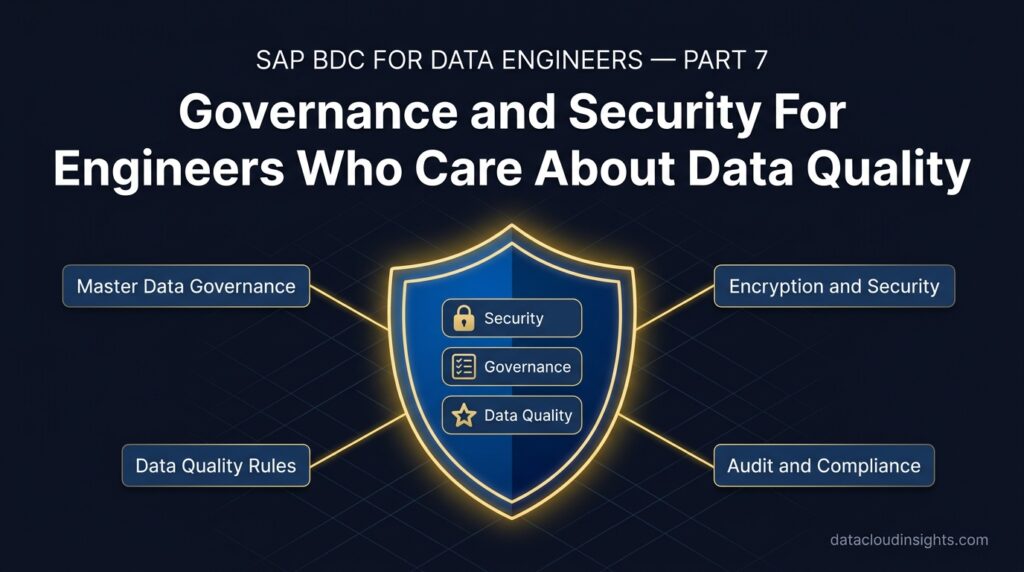

This is Part 7 of our SAP Business Data Cloud for Data Engineers series. In Parts 1 to 6 we covered what BDC is, the architecture, Databricks integration, Data Product design, Azure integration, and migration considerations. Now we tackle the topic that determines whether a BDC implementation becomes a trusted data platform or an expensive data silo — governance and security.
The governance conversation nobody has early enough
There is a pattern that repeats on almost every BDC implementation.
The first three months are exciting. The architecture is designed. The Data Products are being built. The Databricks connection is working. The first SAC dashboards are coming together and stakeholders are impressed.
Then someone from the compliance team joins a project meeting. They ask seven questions about data residency, audit logging, access control design, master data quality, encryption at rest, GDPR data subject rights, and how the platform handles regulatory reporting requirements.
The room goes quiet.
Not because the answers do not exist. But because nobody designed for them from the start. The governance architecture was going to be handled later. Later has arrived and it turns out later is expensive.
For organisations pursuing AI at scale, data quality, master data governance, and shared business definitions are not back-office concerns. They are AI readiness requirements. Clarkston Consulting
This is the most important sentence from SAP Sapphire 2026 for data engineers to internalise. Governance is not a compliance checkbox. It is the prerequisite for every AI use case the organisation wants to build on BDC data.
Marie learned this in month five of the RetailCo project. Joule was configured. The Data Products were published. The finance team started asking Joule questions about supplier spend. The answers were technically correct but commercially wrong — because the vendor master data in S/4HANA had duplicate records, inconsistent naming conventions, and currency assignments that had never been cleaned up after a 2019 acquisition.
Joule was giving accurate answers about bad data. And bad AI answers based on accurate-but-dirty data are worse than no answers at all — because they look authoritative.
The RetailCo team spent six weeks fixing master data that should have been governed before the project started. This part of the series is about not making that mistake on your project.
The BDC governance architecture — four interconnected layers
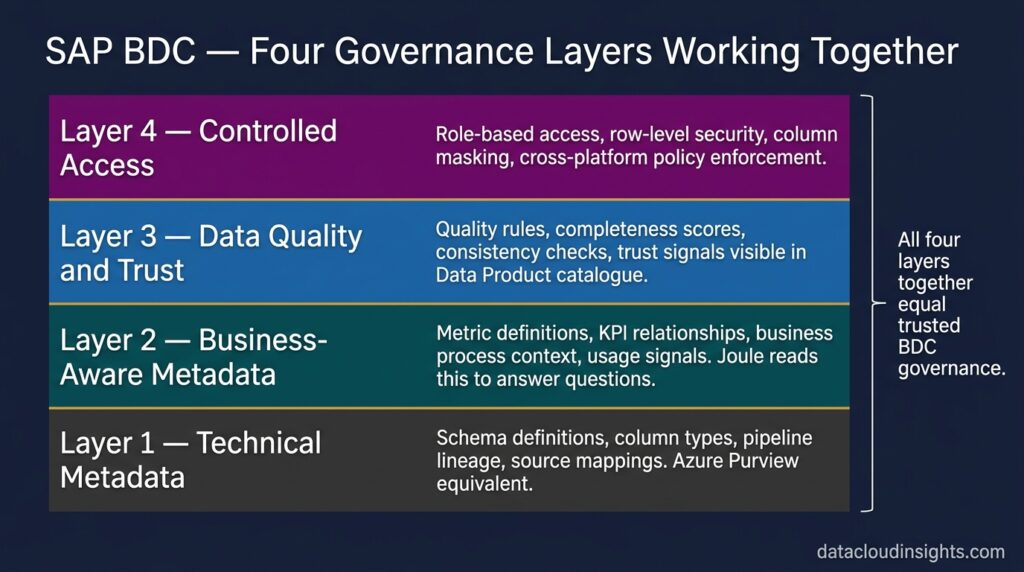
Governance in SAP Business Data Cloud is not a single capability — it is four interconnected layers. Technical metadata like schemas and pipelines, active business-aware metadata that carries context including metric definitions and KPI relationships, data quality and trust signals that inform how data is used, and controlled access across systems, domains, and users. (Sap)
Understanding these four layers separately — and how they interact — is the foundation of a well-designed BDC governance architecture.
Layer 1 — Technical metadata
Technical metadata is the structural information about your data. Schema definitions. Column data types. Table relationships. Pipeline lineage. Source system mappings. This is the metadata that data engineers are most comfortable with — it is what Unity Catalog manages in Databricks, what the dbt manifest captures, what Azure Purview scans and catalogues.
In BDC, technical metadata is managed primarily within SAP Datasphere’s built-in catalogue. Every Data Product published in the Data Product Studio automatically generates technical metadata — schema, column definitions, source lineage, transformation logic. No manual catalogue population required. The metadata is a live reflection of what exists, not a separately maintained document that drifts from reality.
Layer 2 — Business-aware metadata
Active business-aware metadata carries context including definitions of metrics and KPIs, relationships between data entities, business processes and rules, as well as lineage, usage, and quality signals. This metadata connects everything, embedding business context directly into the data so it can be consistently understood and acted on across the organisation. (Sap)
Business-aware metadata is what separates BDC from a generic data platform. A field named cost_ctr_id in a technical metadata catalogue is just a string column. In BDC’s business-aware metadata layer that same field has a business description, a relationship to the cost centre hierarchy in SAP’s organisational model, an association with the relevant SAP business process, and usage signals showing which Data Products and Stories consume it.
This is the metadata that Joule reads to understand what fields mean and how to use them when answering business questions. Investing in rich business-aware metadata is directly investing in Joule answer quality. The relationship is that direct.
Layer 3 — Data quality and trust signals
Built-in data quality monitoring and lineage tracking help organisations maintain compliance and audit requirements without creating bottlenecks. (FitGap)
Data quality in BDC is not a batch profiling job that runs once a week and produces a report nobody reads. It is an active trust signal embedded in every Data Product. Each Data Product has defined quality rules that run on every refresh cycle — completeness checks, consistency checks, referential integrity checks, business rule validations. The quality score from those rules is visible to consumers in the Data Product catalogue alongside the Data Product description and SLA.
A consumer browsing the catalogue sees that the Financial Statement Data Product has a current quality score of 98.7 percent, that two cost centres had missing actual data in last night’s refresh, and that the issue is under investigation by the Finance Data Product owner. That transparency builds consumer trust. A Data Product catalogue where quality is invisible breeds the opposite.
Layer 4 — Controlled access
Controlled access across systems, domains, and users — as AI becomes more autonomous, governance ensures that autonomy remains aligned, so every action is traceable, compliant, and grounded in trusted business context. Sap
Access control in BDC is multi-layered. Platform-level roles control who can create and manage Data Products versus who can only consume them. Data Product-level access controls define which roles can access which Data Products. Row-level and column-level restrictions limit what data within a Data Product specific users can see. And all of these controls propagate automatically across consumption channels — the same access policy that restricts a user in the BDC catalogue restricts them in Databricks when they access the Data Product via Delta Sharing, in SAC when they view a Story built on that Data Product, and in Joule when they ask a question that would require that data to answer.
One access policy. Consistent enforcement everywhere. No gap between what the catalogue says a user can see and what they can actually query.
SAP Master Data Governance — now a core BDC component
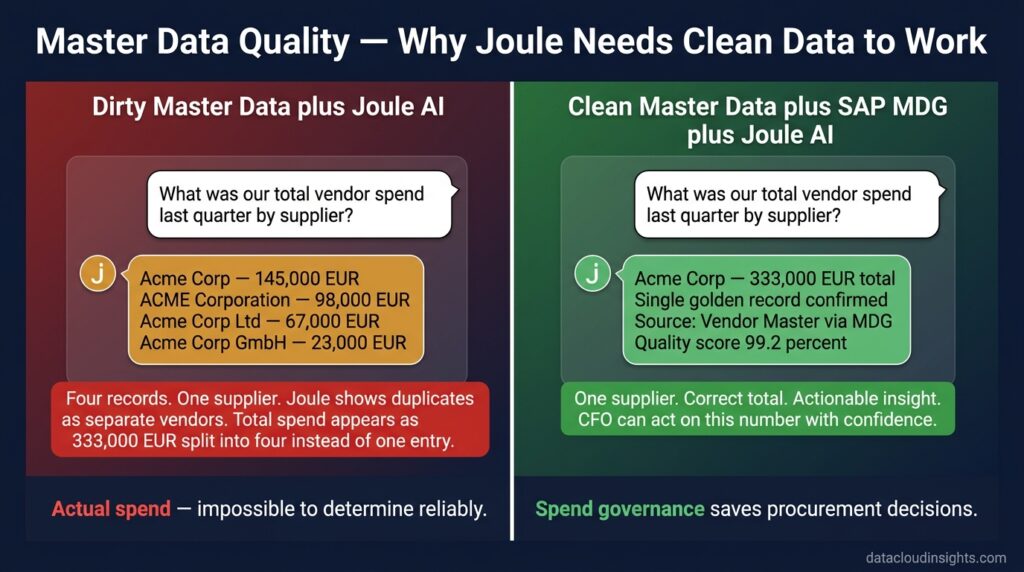
SAP announced at Sapphire 2026 that SAP Master Data Governance is available as a core component of BDC to support stronger governance across the business data fabric. (Clarkston Consulting)
This announcement is significant for data engineers on BDC projects because it directly addresses the root cause of the problem Marie encountered — bad master data producing authoritative-looking but wrong AI answers.
SAP Master Data Governance — MDG — is SAP’s enterprise platform for governing master data. Vendor master data. Customer master data. Material master data. Financial master data — chart of accounts, profit centres, cost centres. MDG provides the workflow, approval, deduplication, and distribution capabilities that keep master data clean and consistent across SAP systems.
In data engineering terms MDG is the equivalent of a data stewardship platform with workflow capabilities — like Ataccama, Informatica MDM, or a heavily customised dbt-based data quality pipeline combined with a ticketing system for data issue resolution. The difference is that MDG understands SAP’s data model natively, integrates with S/4HANA’s organisational structures, and now connects directly into BDC’s data fabric layer.
The practical implication for BDC projects — if your organisation does not have MDG deployed or does not have active master data stewardship processes, you need to address this before your AI use cases go live. The sequence that consistently fails is build the data platform, build the AI capabilities, then discover the master data is too dirty for AI to work reliably. The sequence that works is assess master data quality, clean the critical domains, implement governance processes, then build AI on top of trusted foundation data.
Ericsson unified semantics and business context across petabytes of data spanning 180 countries driven by governed, reusable data products. Vodafone reduced its BW footprint by 80 percent through consolidating multiple markets into a single semantic layer delivering governed, trusted data that serves 350 million customers. SAP
Both of those outcomes required significant master data governance investment before the technical platform could deliver at that scale. The platform capabilities are necessary but not sufficient — the data governance discipline is what makes the platform valuable.
Security architecture — what every data engineer needs to know
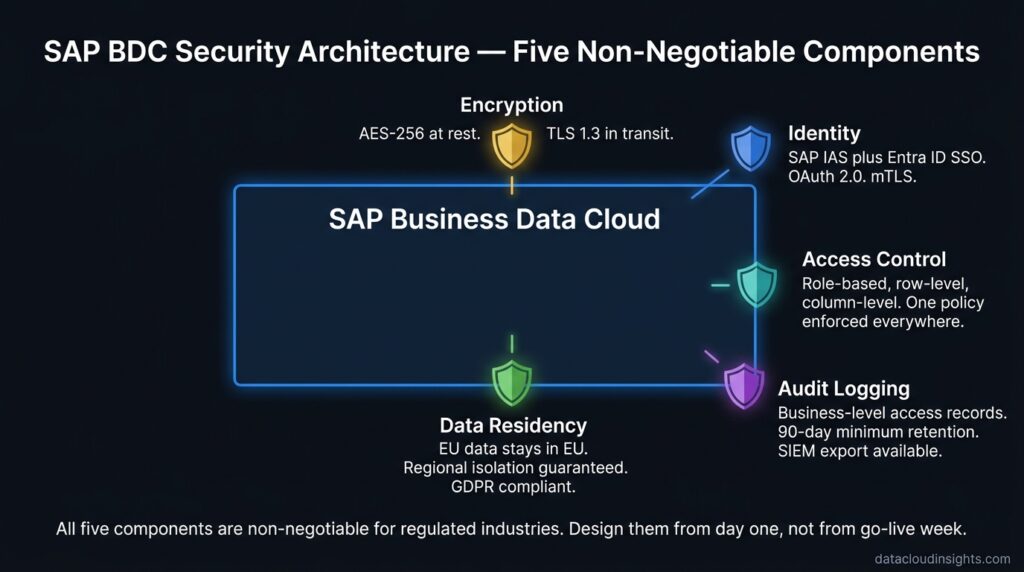
Data moving between source systems and SAP Business Data Cloud is protected through end-to-end encryption and strong authentication mechanisms. These are non-negotiable topics, especially for those in regulated industries.(SAP Community)
The BDC security architecture has five components that come up in every security review and compliance workshop. Understanding them prevents the three-week security review delays that most BDC projects experience when the security architecture was not documented from the start.
Encryption at rest and in transit
All data stored in SAP BDC — in Datasphere’s local tables, in the Data Product catalogue, in SAC’s planning storage — is encrypted at rest using AES-256. All data in transit between BDC components and between BDC and external systems uses TLS 1.3. These are industry standard encryption levels and meet the requirements of GDPR, SOC 2, ISO 27001, and most regulated industry frameworks including DORA for financial services in Europe.
For data engineers the practical note — when you configure federation connections from Datasphere to external data sources like Azure Data Lake or Databricks, the connection uses TLS for in-transit encryption. The external data in Azure remains encrypted by Azure’s own at-rest encryption. BDC does not decrypt and re-encrypt federated data — it reads it through the encrypted transport layer and the data remains under Azure’s encryption at the source.
Data residency and regional isolation
BDC is deployed in specific cloud regions. Customer data does not leave the configured region without explicit configuration to enable cross-region replication. For European customers running SAP on EU data centres — financial and personal data stays within the EU boundary by default.
This is the question that compliance teams ask first. The answer for most European deployments — BDC runs in SAP’s EU20 or EU10 data centres and data residency within the EU is guaranteed by the service agreement. Specific country-level residency requirements — French data sovereignty requirements under SecNumCloud certification for example — require specific contractual arrangements beyond the standard BDC service terms.
Identity and access management
BDC uses SAP’s Identity Authentication Service as its primary identity provider. For organisations using Microsoft Entra ID as their enterprise identity platform — as covered in Part 5 — SAML 2.0 federation between Entra ID and SAP IAS enables SSO. Users authenticate once to their Microsoft identity and access BDC-powered applications without a separate SAP login.
Service-to-service authentication between BDC components and external systems uses OAuth 2.0 with short-lived tokens rather than long-lived credentials. The mTLS plus OAuth dual-layer model from Part 3 for BDC Connect connections is the specific implementation of this principle for Databricks and hyperscaler integrations.
Audit logging
BDC provides comprehensive audit logging covering data access events, configuration changes, Data Product access grants and revocations, user login and logout events, and administrative actions. (SAP Community)
For data engineers the important detail — audit logs in BDC are not just system logs. They are business-level access records. The audit log records that user X accessed Data Product Y at time Z, not just that an API call was made to an endpoint. That business-level specificity is what compliance teams need for GDPR subject access requests, financial audit trails, and data breach investigations.
Audit logs are retained for a minimum of 90 days within BDC and can be exported to external SIEM systems — Microsoft Sentinel, Splunk, Azure Monitor — for longer retention and correlation with security events from other systems.
Security events, system logs, and performance metrics should be correlated to detect anomalies and respond to incidents effectively. Modern SAP infrastructures rely on complex network architectures and security controls must account for internal communication between SAP components, integrations with external systems, and user access. (gTrigyn Technologies)
The practical advice — connect BDC audit logs to your existing SIEM from day one of the project. Not as an afterthought when a compliance audit requests evidence. The log pipeline from BDC to your SIEM is a two-hour configuration task when done proactively and a multi-week incident reconstruction when done reactively.
Network security and Cloud Connector
For organisations connecting BDC to on-premise SAP systems via SAP Cloud Connector — as covered in Part 6 — the Cloud Connector tunnel uses TLS with certificate-based mutual authentication. No inbound firewall ports are opened. The Cloud Connector server in your network initiates the outbound tunnel and SAP BTP’s connectivity service manages the relay.
The Cloud Connector server itself is a security boundary. It should run on a hardened server with minimal installed software, regular patch cycles, monitored uptime, and certificate rotation on a defined schedule. Treat it like network infrastructure, not like an application server. Its availability is a single point of failure for BDC connectivity to your on-premise systems — address this with a high-availability Cloud Connector configuration as discussed in Part 6.
The data quality framework — practical implementation
Master data including customer, vendor, material, and financial information forms the backbone of every SAP environment. Errors in master data affect multiple business processes leading to operational inefficiencies and inaccurate reporting. Centralising master data creation, approval, and distribution helps establish a single source of truth across SAP landscapes. (Gemini-us)
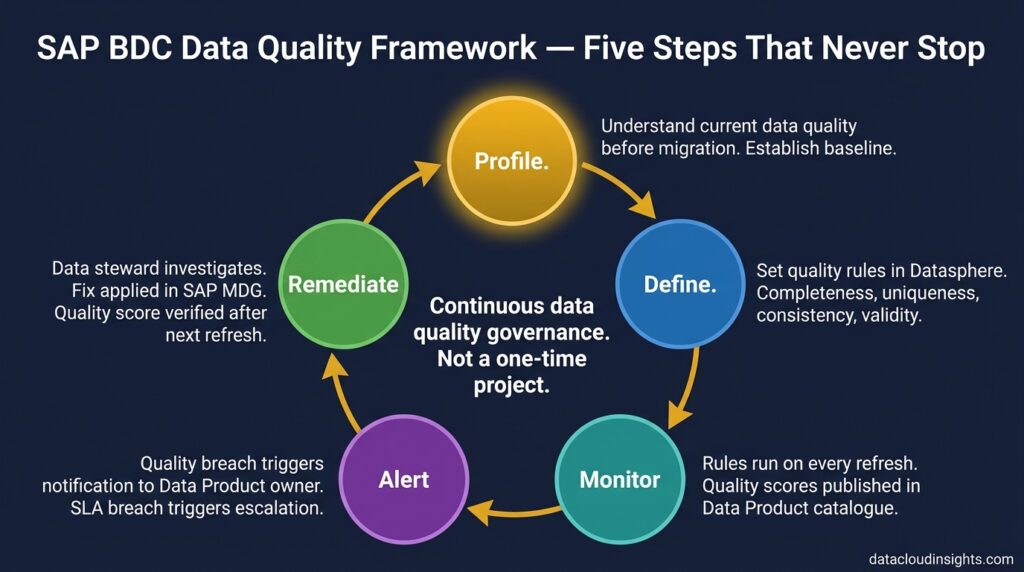
Implementing a data quality framework in BDC is not a technical task that data engineers can complete in isolation. It requires collaboration between data engineers, business data stewards, domain owners, and compliance stakeholders. But the technical implementation is the data engineer’s responsibility and it has five components.
Component 1 — Data profiling before migration
Before migrating any data into BDC’s governed layer, profile it. Understand the current state of completeness, uniqueness, consistency, and validity. For vendor master data — how many duplicate vendor records exist? What percentage of vendors have complete bank account information? What percentage have inconsistent country code assignments across different SAP systems?
This profiling work is not glamorous but it is essential. The profiling output becomes the baseline against which you measure data quality improvement after governance processes are implemented. Without a baseline you cannot demonstrate that governance is working.
Component 2 — Data quality rules in Datasphere
Datasphere supports data quality rules defined on Local Tables and Views. Define rules that match your business requirements:
Completeness rule — every Financial Statement record must have a non-null cost centre assignment. Alert if completeness falls below 99 percent.
Uniqueness rule — every vendor in the Vendor Master Data Product must have a unique tax identification number. Alert if duplicates are detected.
Consistency rule — the currency code on every purchase order line must exist in the currency master table. Alert if orphaned currency codes are detected.
Validity rule — all date fields must contain valid calendar dates within the expected range for the business process. Alert if dates fall outside expected bounds.
These rules run automatically on every data refresh. Quality scores are published to the Data Product catalogue. Violations generate alerts to the Data Product owner who investigates and resolves.
Component 3 — Master data stewardship process
Technical data quality rules catch symptoms. Master data stewardship processes fix root causes.
A data quality rule that detects 47 duplicate vendor records in the vendor master alerts the vendor data steward. The steward investigates, identifies which record is the golden record, merges the duplicates in SAP MDG, and monitors that the fix propagates through the BDC data pipeline to the Vendor Data Product.
Without an active stewardship process the alert fires, nobody investigates, duplicates persist, and the data quality score stays below acceptable levels indefinitely. The technical tool is necessary but the human process is what makes governance work.
Appoint business data stewards and data owners to manage daily data quality, enforce standards, and oversee specific business domains. Clearly defined responsibilities reduce ambiguity and improve accountability across the organisation. Gemini-us
On the RetailCo project Marie worked with the finance team to establish data stewards for three master data domains — vendor master, cost centre master, and product master. Each steward received training on how to investigate data quality alerts in BDC’s quality monitoring interface, how to make corrections in S/4HANA via MDG workflows, and how to verify that corrections propagated correctly to BDC Data Products.
The stewardship model added four people’s part-time effort to the project. It also ensured that Joule’s answers about supplier spend, cost centre performance, and product margins were trustworthy enough for the CFO to act on. That trustworthiness is what justified the entire BDC investment from a business perspective.
Component 4 — Lineage documentation and impact analysis
BDC’s lineage tracking automatically records where data comes from and where it goes. But lineage is only useful if someone uses it.
Establish a practice of consulting lineage before making changes to Data Products. Before modifying the schema of the Financial Statement Data Product — run an impact analysis. Which SAC Stories consume it? Which Databricks ML models use it? Which Joule capabilities depend on it? The lineage graph answers these questions in seconds. Without consulting it, a schema change breaks downstream consumers silently.
Make impact analysis a formal step in the Data Product change management process. No schema change goes live without a completed impact analysis reviewed by all affected Data Product owners.
Component 5 — Data quality SLAs and escalation
Define data quality SLAs alongside refresh SLAs. The Financial Statement Data Product must have a data quality score above 98 percent after each refresh. If it falls below 98 percent, the Data Product owner is automatically notified. If the quality is not restored within four hours, the escalation path triggers — the finance domain lead is notified and a P2 incident is opened.
This SLA and escalation structure prevents the situation where a Data Product silently serves low-quality data for three weeks before anyone notices. It also gives consumers confidence — they know that if data quality falls below the published SLA they will be notified before they consume incorrect data in reports or AI responses.
GDPR and regulatory compliance — the questions you will be asked
European data engineers working with BDC will inevitably face GDPR compliance questions. Here are the questions that come up in every compliance review and the answers.
Does BDC store personal data?
Yes, potentially. SAP HR data in SuccessFactors includes employee personal data. SAP CRM data includes customer personal data. Whether that personal data flows into BDC depends on which Data Products you implement and which source system data they include. Document which Data Products contain personal data as part of your Data Product catalogue metadata.
How are data subject access requests handled?
GDPR Article 15 gives data subjects the right to access their personal data. In a BDC context this means being able to identify all personal data about a specific individual across all Data Products that contain personal data and extract it in a machine-readable format. BDC does not automate this natively — you need a process and tooling for DSAR response that queries the relevant Data Products and assembles the response. Design this process before go-live, not when the first DSAR arrives.
How is the right to erasure implemented?
GDPR Article 17 gives data subjects the right to erasure of their personal data. In a data platform context this is complex — personal data may exist in current Data Product snapshots, in historical versions of Local Tables, in audit logs, and in replicated copies in external systems connected via BDC. Define your data retention and erasure architecture at design time. Know which personal data is where and how it gets erased when a right-to-erasure request is received.
Where does data reside?
As discussed in the security section — BDC data stays in the configured cloud region. For GDPR purposes European personal data remains in EU data centres. Document the data residency configuration in your Data Processing Agreement with SAP.
How are data breaches detected and reported?
GDPR Article 33 requires notification of data breaches to supervisory authorities within 72 hours. BDC’s audit logging and SIEM integration provides the detection capability. The 72-hour notification requirement means the detection-to-notification process needs to be defined and tested before a breach occurs. Include BDC in your organisation’s incident response playbook.
The governance maturity model — where to start
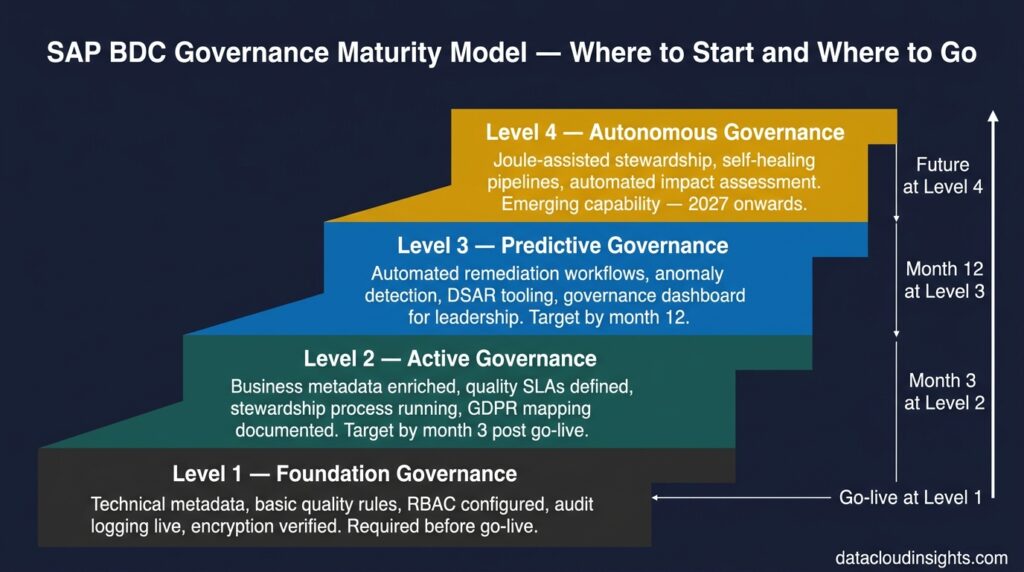
Not every organisation can implement all of this governance capability simultaneously. The governance maturity model helps prioritise.
Level 1 — Foundation governance (implement before go-live)
Technical metadata in Datasphere catalogue. Basic data quality rules on critical Data Products. Role-based access control configured. Audit logging connected to SIEM. Encryption verified. Data residency documented. Without Level 1 you should not go live.
Level 2 — Active governance (implement in first three months after go-live)
Business-aware metadata enriched by domain stewards. Data quality SLAs defined and monitored. Master data stewardship process operational. Impact analysis practice established. GDPR data mapping documented.
Level 3 — Predictive governance (implement in months three to twelve)
Automated data quality remediation workflows. ML-based anomaly detection on data quality metrics. Automated DSAR response tooling. Data product usage analytics driving stewardship prioritisation. Governance dashboard for leadership visibility.
Level 4 — Autonomous governance (longer term)
This creates a constant cycle, not a linear pipeline. Data informs context, context shapes decisions, and those decisions generate new data that continuously improves the system. (Sap)
Joule-assisted data stewardship where the AI identifies data quality issues and suggests remediation. Automated lineage-based impact assessment for all Data Product changes. Self-healing data pipelines that detect and correct common data quality issues without human intervention.
Most organisations reach Level 2 within six months of go-live. Level 3 within eighteen months. Level 4 is the direction BDC is heading with Joule embedded in governance workflows — it is an emerging capability not a current production reality for most implementations.
The governance decisions that determine project success
Based on BDC governance implementations in 2026 these are the decisions that consistently determine whether a BDC governance architecture becomes a genuine organisational asset or a compliance documentation exercise that nobody uses.
Decision 1 — Governance as architecture, not afterthought
In 2026, SAP infrastructure and security alignment is no longer a technical optimisation. It is a strategic imperative. Trigyn Technologies
The single most important governance decision is making it an architectural concern from project day one rather than a compliance activity added at the end. This means including data stewards in blueprint workshops, defining data quality rules before Data Products are published, and making governance SLA compliance a go-live criterion with the same weight as functional requirements.
Decision 2 — Executive sponsorship with real authority
Executive sponsorship is equally important to drive organisational commitment and ensure governance remains a strategic priority. Gemini-us
Data governance programmes without executive sponsorship consistently fail. Not because the technical implementation is wrong but because domain teams do not prioritise stewardship activities when competing with operational pressures. An executive sponsor who reviews the governance dashboard monthly and holds domain leads accountable for data quality SLA compliance changes the incentive structure. Data quality becomes a performance metric rather than a background nicety.
Decision 3 — Governance enables rather than restricts
The governance frameworks that generate organisational resistance are those that say no — no, you cannot access that data, no you cannot change that schema, no you cannot publish that Data Product until all metadata is complete.
The governance frameworks that generate organisational adoption are those that say yes faster — yes you can access that data because we know exactly who owns it and we can provision access in four hours, yes you can publish that Data Product and here is the fast-track metadata template, yes Joule can answer questions about this domain because the data quality score meets the threshold.
This approach balances the need for democratised data access with enterprise-grade security and governance requirements that are critical for regulated industries. (FitGap)
Design your governance architecture around enabling data access and AI use cases faster and more reliably, not around preventing misuse. Prevention is a necessary constraint. Enablement is the value proposition that gets business stakeholders to invest in making governance work.
What Part 8 covers
Part 7 gave you the complete BDC governance and security picture — the four-layer governance architecture, SAP MDG as a core BDC component, the security architecture components, the practical data quality framework, GDPR compliance considerations, the governance maturity model, and the decisions that determine governance success.
Part 8 is the final part of the series — the SAP BDC certification guide. Which certifications exist, what the C_BCBDC exam covers, how to prepare as a data engineer, what you already know from your existing background, and what to study specifically. The shortest path from data engineer to certified BDC professional.
The complete BDC for Data Engineers series:
- Part 1 — What is SAP Business Data Cloud? (published)
- Part 2 — BDC Architecture — the data engineer’s translation guide (published)
- Part 3 — BDC and Databricks — partners not competitors (published)
- Part 4 — Data Products — design, governance and engineering decisions (published)
- Part 5 — BDC and Azure — the complete integration guide (published)
- Part 6 — BDC vs your current stack — honest migration guide (published)
- Part 7 — BDC governance and security (you are here)
- Part 8 — BDC certification guide — C_BCBDC for data engineers (coming soon)
Subscribe below to get notified when Part 8 publishes.
Related reading on Data Cloud Insights
- SAP Business Data Cloud for Data Engineers — Part 1
- SAP BDC Architecture Explained
- SAP BDC Data Products Design and Governance
- SAP BDC Architecture with Real Examples
Published by the Data Cloud Insights team — SAP data professionals with hands-on implementation experience across Europe, bridging modern cloud data engineering and the SAP BDC ecosystem.