
This is Part 8 — the final part of our SAP Business Data Cloud for Data Engineers series. In Parts 1 to 7 we covered what BDC is, the architecture, Databricks integration, Data Products, Azure integration, migration considerations, and governance and security. Now we close the series with the question Marie asked at the end of month six on the RetailCo project — how do I get certified in this?
The exam that changed everything in 2026
If you have been searching for C_BCBDC preparation material and found yourself confused by conflicting information — there is a good reason. The exam changed fundamentally in 2026 and most preparation material available online has not caught up yet.
SAP has fundamentally changed the C_BCBDC certification exam format. Instead of cramming facts and guessing at multiple choice questions, you are invited to think like you do on the job. You will work through real scenarios, connect the dots, and show how you deliver outcomes. (SAP Community)
This is not a minor update. It is a complete rethinking of what certification means. The old format tested whether you had memorised SAP terminology and feature descriptions. The new format tests whether you can apply BDC knowledge to real business situations — the same situations you encounter on actual projects.
The C_BCBDC exam questions are no longer isolated pieces of trivia. You will not be asked what does button X do. Instead the exam evaluates your mastery of database management, data storytelling, architecture comprehension, and platform task execution within realistic business contexts. (ERPPrep)
For data engineers this change is actually good news. The old SAP exam format rewarded memorisation — which put people with practical experience at a disadvantage compared to people who had spent weeks reading documentation. The new format rewards exactly what data engineers have — the ability to analyse a technical situation, understand the constraints, and design the right solution.
Marie passed C_BCBDC on her first attempt. She spent eight weeks preparing. She told me afterwards that the exam felt less like a test and more like a project consultation — which was both more challenging and more satisfying than she expected.
This guide tells you exactly how to prepare for that consultation.
What the C_BCBDC certification covers
C_BCBDC is SAP’s associate-level credential for SAP Business Data Cloud — SAP’s fully managed data and AI platform that unifies and governs SAP data, connects third-party data, and delivers it for analytics and decision-making. The exam validates that you understand the platform’s architecture and its core building blocks — how data is federated and modelled, how it is analysed and planned on, and how it is packaged as governed Data Products. (Powerkram)
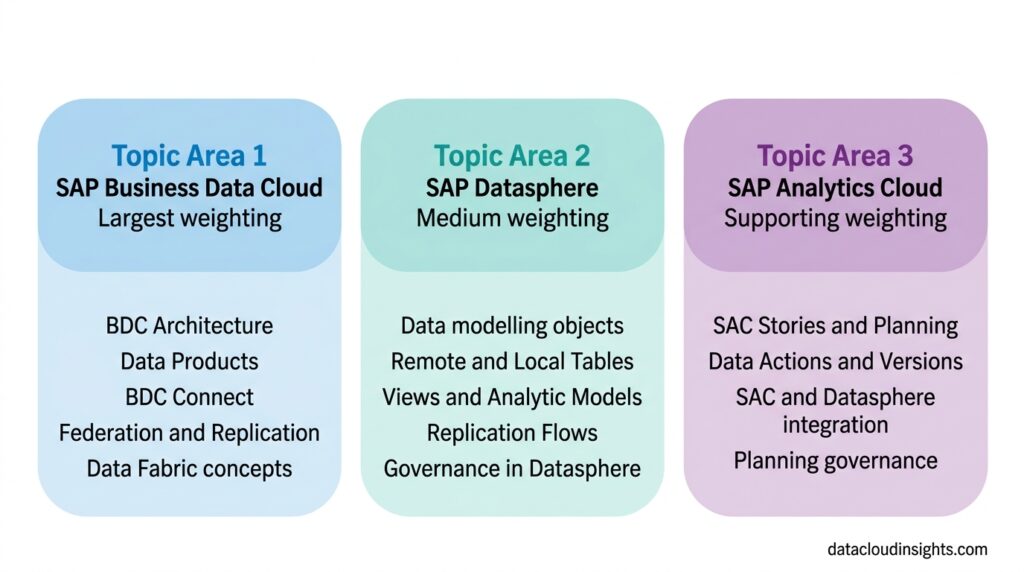
The exam covers three weighted topic areas:
Topic Area 1 — SAP Business Data Cloud
This is the largest weighted topic area. It covers BDC architecture, Data Products, the Data Product Studio, BDC Connect for Databricks and hyperscalers, federation and replication patterns, and the business data fabric concept. Everything covered in Parts 1 to 4 and Part 6 of this series maps directly to this topic area.
Topic Area 2 — SAP Datasphere
Datasphere modelling — Remote Tables, Local Tables, Views, Analytic Models, Replication Flows, data governance in Datasphere, identity and access management, and the integration between Datasphere and external platforms. Part 2 and Part 7 of this series cover the concepts you need here.
Topic Area 3 — SAP Analytics Cloud
Stories, Planning Models, Data Actions, the SAC and Datasphere integration, and the consumption layer of the BDC architecture. If you have also followed the SAC for Data Engineers series on this blog — you already have strong coverage of this topic area.
This associate credential fits data and analytics professionals working across the SAP data landscape. Data analysts and BI specialists building stories and planning models. Solution consultants and data architects modelling and federating data in SAP Datasphere. SAP BW professionals transitioning on-premise skills to the cloud data fabric. Data engineers integrating BDC with hyperscaler platforms and SAP Databricks. (Powerkram)
That last description — data engineers integrating BDC with hyperscaler platforms — is exactly the profile this series has been written for. You are already the target audience for this certification.
The new exam format — AI scenario-based assessment
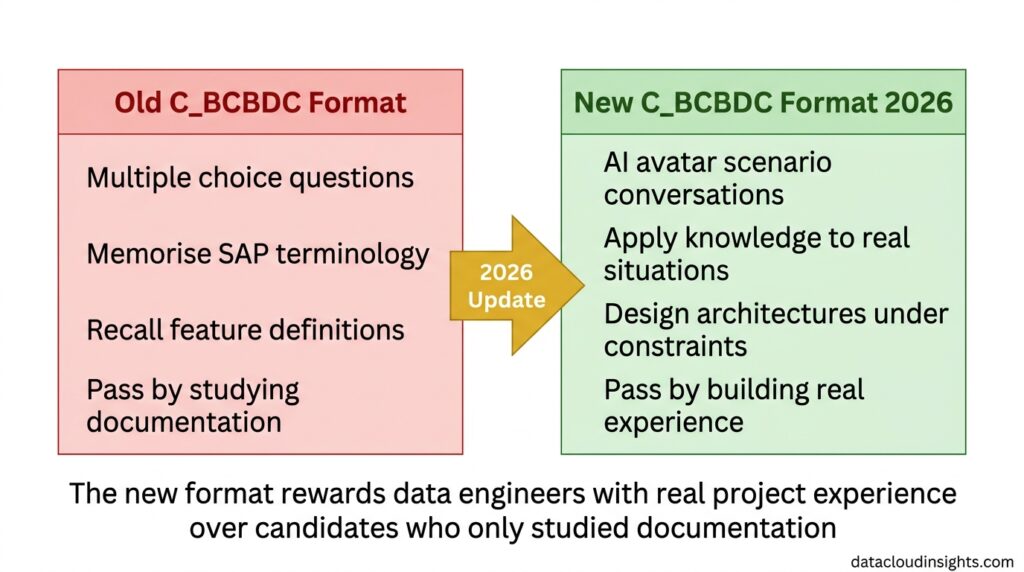
You will interact with an AI avatar to respond to real customer or project situations. For learners who prefer not to use AI there is an alternative option to upload a video for human review. (SAP Community)
This is the most surprising change for candidates who prepared for the old format. You are not answering multiple choice questions. You are having a conversation with an AI avatar that presents you with realistic business scenarios and asks how you would respond.
Stepping into the SAP Business Data Cloud exam is no longer just a test of your memory. It means stepping into a virtual consulting engagement where every decision has cascading consequences. (ERPPrep)
A typical scenario might go like this:
The AI avatar presents you as a BDC architect at a retail company with 80 stores across Europe. The company runs SAP S/4HANA for finance and has an existing Azure Data Lake with e-commerce data. They want to combine SAP financial actuals with e-commerce revenue in a single governed report and use Joule to answer supplier spend questions. The vendor master data has known quality issues.
The avatar then asks you a series of questions:
- How would you design the data integration architecture for this requirement?
- Which connection pattern would you use for the Azure Data Lake data — federation or replication and why?
- What governance steps would you take before enabling Joule on the supplier data?
- How would you structure the Data Products to serve both the SAC dashboard and the Joule queries?
Sound familiar? It should. It is the RetailCo project from this entire series — exactly the kind of real-world scenario you have been reading about for seven parts.
I passed the C_BCBDC exam by spending most of my time on hands-on navigation in Business Data Cloud, since the scenario questions hinge on knowing where things are and how they actually work rather than being able to recite definitions. Pass4Success
That observation from a recent exam passer is the single most important piece of preparation advice in this post. Hands-on experience in BDC is more valuable than reading documentation. The scenarios test whether you know how to do things — not whether you can describe what they are.
What data engineers already know — your head start
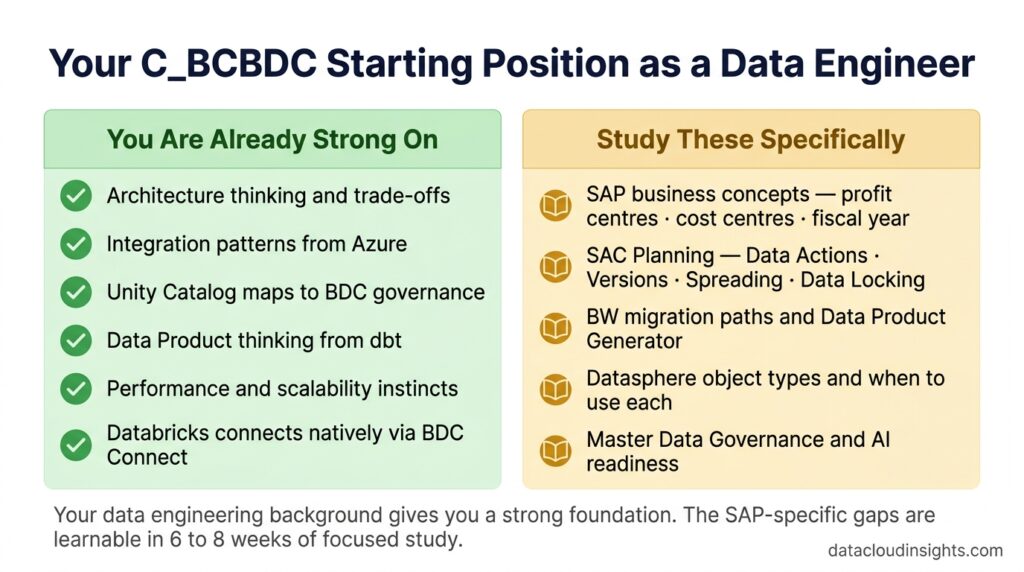
Coming from a data engineering background with Azure and Databricks experience you already know more than you think for this exam. Here is an honest assessment of your starting position.
You are strong on:
Architecture thinking — the exam rewards structured thinking about data flows, integration patterns, and trade-off analysis. Data engineers think this way naturally. The instinct to ask what is the data source, what is the transformation, what is the consumption pattern — that is exactly what the exam scenarios require.
Integration patterns — federation versus replication, live connection versus import, zero-copy versus replicated storage. You understand these trade-offs from your Azure experience and the BDC equivalents map directly.
Governance concepts — Unity Catalog experience translates directly to BDC Data Product governance. Data lineage, access control, quality monitoring — these are not new concepts for you even if the specific BDC tooling is.
Data Product thinking — if you have worked with data mesh principles, dbt semantic layers, or any form of curated data product in your Databricks work, the BDC Data Product concept will feel familiar even if the implementation differs.
Performance and scalability thinking — the instinct to question query performance, data volumes, refresh frequencies, and SLA implications is natural for data engineers and directly relevant to exam scenarios.
You need to study specifically:
SAP-specific business concepts — profit centres, cost centres, company codes, fiscal year variants, chart of accounts hierarchies. These concepts underpin the business context that BDC preserves and you need to understand them well enough to design around them.
SAC Planning capabilities — if you have not worked with SAC Planning before, Data Actions, Versions, Spreading, and Data Locking need focused study. This is genuinely different from anything in the Azure and Databricks world.
BW migration patterns — the BW Data Product Generator, migration path options, and the coexistence patterns during transition are exam topics that data engineers without BW background will find new.
SAP Datasphere modelling objects — the specific object types, their capabilities and limitations, and when to use Remote Tables versus Local Tables versus Views is detail you need to know precisely.
Master Data Governance concepts — the role of MDG in BDC, how master data quality affects AI outputs, and the stewardship process are governance topics specific to the SAP world.
Your 8-week study plan
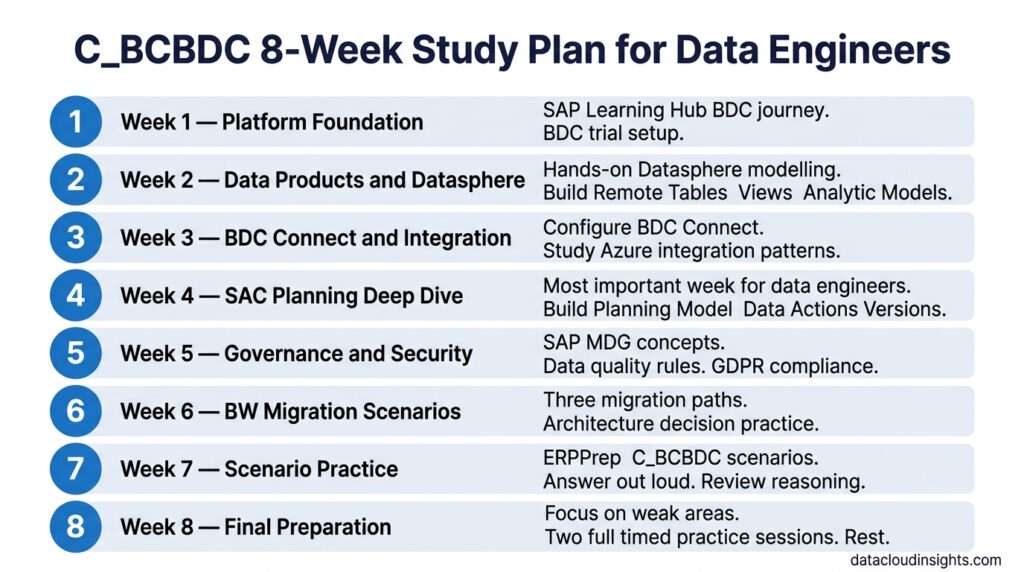
This plan is designed specifically for data engineers with Azure and Databricks experience. It accounts for what you already know and focuses your energy on the gaps.
Week 1 — Platform foundation
Complete SAP’s official BDC learning journey on SAP Learning Hub. Do not skip modules even for topics you think you know — the official SAP framing of concepts is what the exam tests, not generic data engineering equivalents.
Re-read Parts 1 and 2 of this series with exam preparation in mind — note the specific BDC terminology for every concept.
Set up your BDC trial environment. Hands-on access is essential. If you do not have a BDC trial, use the SAP Datasphere free tier and SAC trial as your starting point.
Week 2 — Data Products and Datasphere deep dive
Spend this week entirely in the Datasphere interface. Create Remote Tables connected to different source types. Build Views with SQL transformations. Create Analytic Models. Understand the difference between each object type not from documentation but from building them.
Complete the Datasphere-specific learning modules on SAP Learning Hub focusing on federation and replication configuration.
Re-read Parts 3 and 4 of this series. Note every Data Product design principle and be able to explain why each one matters in a scenario context.
Week 3 — BDC Connect and integration patterns
Deep dive on BDC Connect for Databricks — set up the connection if you have both environments available. Understand the Delta Sharing protocol, Unity Catalog integration, and the bidirectional sharing patterns.
Study the Azure integration patterns from Part 5 — Microsoft Fabric, ADLS Gen2, Microsoft Entra ID. Understand when to use each pattern and why.
Practice articulating your integration architecture decisions out loud. The scenario-based exam requires you to explain your reasoning, not just select the right answer.
Week 4 — SAC Planning focused study
This is the week that most data engineers need to spend the most time on. SAC Planning is genuinely different from anything in the Azure world and the exam tests it in depth.
Build a Planning Model in your SAC trial. Configure Versions. Create a Data Action that copies actuals to forecast. Set up an Input Schedule. Configure Data Locking on a Version.
Re-read Part 4 of the SAC for Data Engineers series on this blog — the planning concepts explained through Azure analogies will help them stick.
Week 5 — Governance and security
Study SAP Master Data Governance concepts — what it does, how it integrates with BDC, and how master data quality affects Joule accuracy.
Study the BDC security architecture in depth — encryption, identity management, audit logging, GDPR compliance. These come up in governance-focused exam scenarios.
Build data quality rules in your Datasphere trial. Understand how quality monitoring works in the Data Product catalogue.
Re-read Part 7 of this series with exam preparation focus.
Week 6 — BW migration and architecture scenarios
Study the three BW migration paths in depth — Lift Shift Innovate, Selective Migration, and Full Redesign. Understand when to recommend each and what the trade-offs are.
Study the BW Data Product Generator — what it does, what it can and cannot automate, and where manual rebuild is required.
Practice answering architecture decision scenarios. Given a specific client situation — complex BW landscape, tight timeline, limited budget, ambitious AI goals — which migration path would you recommend and why? Practice the structured reasoning not just the conclusion.
Week 7 — Scenario practice
This week is entirely scenario practice. No new concepts — only applying what you know to realistic situations.
Use ERPPrep’s C_BCBDC practice scenarios. These are specifically designed for the new scenario-based format and reflect how questions are actually structured in 2026.
For each practice scenario — answer it, then review the reasoning behind the correct approach, then articulate out loud why that approach is right. The exam tests your ability to explain your reasoning to an AI avatar, so practicing out loud is genuine exam preparation.
Focus especially on scenarios that involve trade-off decisions — live connection versus replication, zero-copy versus mirroring, selective migration versus full redesign. These trade-off scenarios are the most common exam format.
Week 8 — Final preparation
Review every topic area where your practice scores are weakest. Do not review topics you are already strong on — focus your final week on the gaps.
Complete at least two full timed practice sessions under exam conditions. 120 minutes. No interruptions. Full scenario responses.
The day before the exam — do not study. Rest. Review your notes briefly if needed but trust the preparation you have done.
Exam day — what to expect
The exam is 120 minutes. The scenario questions hinge on knowing where things are and how they actually work in the platform rather than being able to recite definitions. (Pass4Success)
Practical advice for the day:
For the AI avatar format:
Speak clearly and structure your answers. The AI avatar evaluates the completeness and logic of your responses not just keyword matching. A well-structured answer that covers the key considerations — what the requirement is, what the recommended approach is, why that approach is right, and what the trade-offs are — scores better than a technically correct but poorly explained response.
Do not rush. 120 minutes for scenario-based questions is more generous than it sounds — take time to think through each scenario fully before responding.
When the scenario presents a situation you recognise from real project experience — use that experience. The exam is designed to test applied knowledge and your RetailCo-equivalent project experience is directly relevant.
For the video upload alternative:
If you choose the video upload option instead of the AI avatar — record yourself explaining your approach to each scenario clearly and logically. Same structured approach — requirement, recommendation, rationale, trade-offs. Good audio quality and clear articulation matter.
After passing — what to do immediately
Add the certification to LinkedIn under Licenses and Certifications. Use exactly this name:
SAP Certified Associate — SAP Business Data CloudInclude the credential ID from your certificate and the issue date.
Post about passing on LinkedIn. Tag SAP. Use these hashtags:
#SAPBusinessDataCloud #CBCBDC
#SAPCertification #DataEngineering #SAP
BDC certification posts get strong engagement in the SAP community right now because the credential is new and relatively few people hold it. Early movers benefit from the novelty.
Update your CV with the certification in the certifications section and add BDC to your skills section.
Consider what certification to pursue next. The natural progression from C_BCBDC:
C_BDCDA — SAP Certified Data Architect — SAP Business Data Cloud
The C_BDCDA certification validates expertise as a Data Architect specialising in SAP Business Data Cloud — a more advanced credential that covers architecture design, governance frameworks, and complex integration patterns at an expert level. Certification-exam
If your role involves designing BDC architectures rather than implementing specific components — C_BDCDA is the natural next step after C_BCBDC.
The series conclusion — Marie’s reflection
Eight months after joining the RetailCo BDC project, Marie sat at her desk with a certificate on her screen.
C_BCBDC. SAP Certified Associate — SAP Business Data Cloud.
She had started the project not knowing what a tenant was. She had ended it having designed the connection architecture between Azure and BDC, led the Data Product governance framework, implemented BDC Connect for the Databricks ML team, and passed the certification on her first attempt.
She thought about the data engineer she had been when the project started. Good at Databricks. Good at Azure. Completely lost in an SAP kickoff meeting.
And she thought about what she understood now that she had not understood then.
SAP data is not just data. It is data with context — organisational hierarchies, fiscal calendars, currency conversions, account structures, business process semantics that took decades to build into the systems that generate it. Every extraction pipeline that had ever moved SAP data into Azure had been trying to preserve that context and failing in small ways that compounded into significant inaccuracies over time.
BDC was not a perfect platform. No platform is. But it was the first serious attempt to solve that specific problem — keeping SAP data connected to its business context as it moved from operational systems to analytics and AI.
The data engineers who understood both worlds — who could speak Azure and Databricks and SAP fluently — were going to be building the most valuable integrations in enterprise data for the next decade.
She closed the certificate tab and opened her IDE.
There was still work to do.
The complete BDC for Data Engineers series
- Part 1 — What is SAP Business Data Cloud and why should data engineers care?
- Part 2 — SAP BDC Architecture — the data engineer’s translation guide
- Part 3 — SAP BDC and Databricks — partners not competitors
- Part 4 — Data Products — design, governance and engineering decisions
- Part 5 — BDC and Azure — the complete integration guide
- Part 6 — BDC vs your current stack — honest migration guide
- Part 7 — BDC governance and security
- Part 8 — BDC certification guide — C_BCBDC for data engineers (you are here)
Related reading on Data Cloud Insights
- SAP BDC Architecture Explained with Real Examples
- SAP BDC Certification Guide — C_BCBDC (your existing post)
- SAP Analytics Cloud Certification Guide
- SAP Analytics Cloud for Data Engineers — Part 1
Published by the Data Cloud Insights team — SAP data professionals with hands-on implementation experience across Europe, bridging modern cloud data engineering and the SAP BDC ecosystem.