
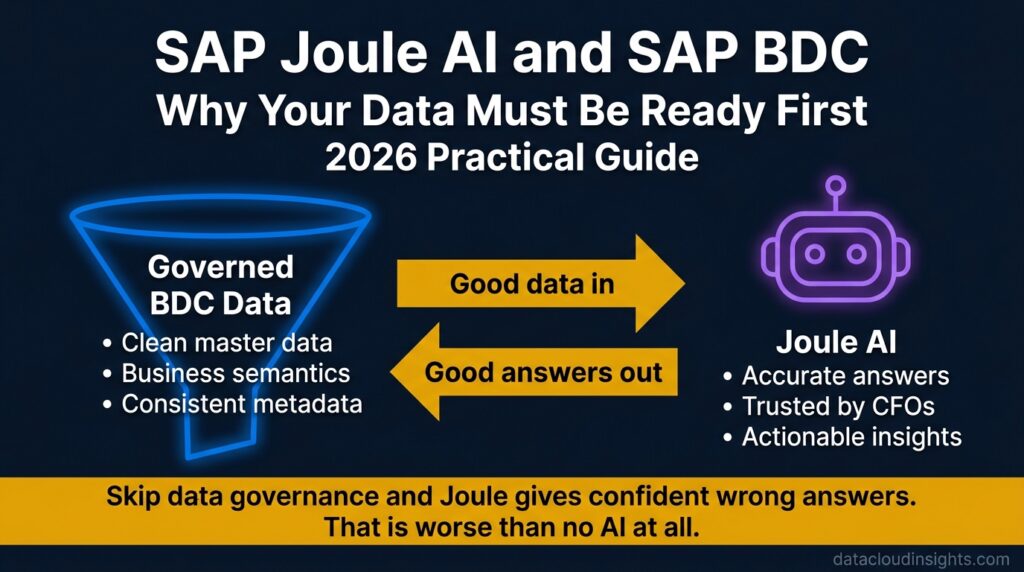

At SAP Sapphire 2026 in May, Joule was the word on everyone’s lips. SAP made a big splash with announcements around the Autonomous Enterprise, Joule Work, new Joule agents and assistants, and the next generation of Joule Studio. The direction is ambitious, move AI beyond isolated copilots and into the processes that run the business. (Protera)
Back in the real world, in the client meetings and implementation workshops that happen after the conference excitement fades, the conversation is different. Not whether Joule is impressive. It is. The question practitioners are actually asking is: our data is a mess across five SAP systems and an Azure Data Lake. Will Joule actually work for us?
The honest answer is: it depends entirely on your data foundation. And SAP Business Data Cloud is that foundation.
What Joule Actually Is — and What It Is Not
SAP Joule is SAP’s generative AI copilot, embedded across SAP’s cloud portfolio including S/4HANA Cloud, SAP SuccessFactors, SAP Ariba, SAP Customer Experience, and SAP Business Technology Platform. (SAVIC Technologies)
Think of Joule as a highly capable assistant that can answer business questions, execute tasks, and run multi-step workflows, but only as well as the data it has access to. Ask Joule what your total vendor spend was last quarter and it will give you an answer. Whether that answer is right depends on whether your vendor master data is clean, consistently structured, and accessible to Joule through a governed data layer.
SAP Joule is SAP’s AI copilot and engagement layer for interacting with SAP applications, data, and business processes using natural language. Joule Studio is SAP’s environment for building and managing custom AI agents, applications, and workflows grounded in SAP business context. (Protera)
Joule is not a search engine you point at your SAP systems. It is an AI agent that reasons over structured, governed, semantically rich data. The richer and more trustworthy that data is, the more useful Joule becomes.
By Q1 2026, SAP’s Business AI release confirms 35 solutions, 30 plus agents, and 2,500 Joule Skills available across the SAP portfolio. The scale is impressive. The limiting factor on most real implementations is not the AI capability. It is the data underneath. (SAVIC Technologies)
Why Joule Needs SAP Business Data Cloud
This is the relationship that SAP’s marketing explains poorly, and that practitioners discover the hard way when Joule gives confidently wrong answers on poorly governed data.
AI and analytics need better business context, and disconnected data estates make that nearly impossible at scale. (SAVIC Technologies)
Joule uses a RAG architecture, Retrieval-Augmented Generation. When you ask Joule a business question, it does not generate the answer from its training data alone. It retrieves relevant data from your SAP systems, interprets it with business context, and generates a grounded answer based on your actual enterprise data.
The quality of that retrieval step determines everything. If Joule retrieves data that is clean, consistently structured, and semantically rich, it gives accurate, actionable answers. If it retrieves data from disconnected systems with inconsistent master data, duplicate records, and missing context , it gives confident-sounding answers that are factually wrong for your organisation.
On a project I worked on recently, a client activated Joule and immediately asked it to summarise their top ten suppliers by spend. Joule returned a list with four entries for the same supplier under slightly different names,the result of duplicate vendor master records that had never been resolved. The answer looked authoritative. It was wrong. Three months of master data governance work followed before Joule was trusted enough to use in actual business decisions.
SAP Business Data Cloud solves this problem structurally. BDC acts as the platform for governed business data, enabling AI and analytics to work with the trusted business context they need. When Joule queries data through BDC’s governed layer, it gets data with SAP business semantics preserved, profit centre hierarchies, currency conversions, organisational structures, fiscal calendars, all the context that makes a number meaningful rather than just accurate. (SAVIC Technologies)
The Three Things BDC Does to Make Joule Work
First — it governs the master data. SAP Master Data Governance is now embedded within BDC as a core component. MDG provides the deduplication, approval workflows, and distribution capabilities that keep vendor master, customer master, material master, and financial master data clean and consistent across SAP systems. Clean master data means Joule returns one supplier record for Acme Corp — not four variations of the same company.
Second — it preserves business semantics. When financial data flows from S/4HANA into BDC’s governed layer, it arrives with its business context intact. The profit centre hierarchy. The cost centre allocation structure. The account hierarchy that maps individual GL accounts to P&L line items. Joule can navigate these structures when answering questions because BDC preserved them. Without BDC, those structures are lost the moment data leaves the SAP system.
Third — it provides consistent metadata for AI understanding. The most significant Q1 2026 Datasphere update is Joule GA. Joule is now embedded directly in the Datasphere interface — data architects, analysts, and business users can navigate the platform, execute tasks, and get answers using natural language. SAVIC Technologies
Three categories of Joule interaction are live in Datasphere.
- Informational — how do I create a replication flow from S/4HANA to a local table? Joule retrieves the documentation and guides you through the steps.
- Operational — run this replication flow now. Joule executes it.
- Analytical — what is our year-to-date gross margin by profit centre? Joule queries the governed analytic model and returns the answer.
- The third category — analytical queries on business data — only works correctly when the underlying data products in Datasphere have complete, accurate business descriptions on every field.
A field called cost_ctr_id with no description gives Joule nothing to work with. The same field with a description explaining that it is the unique identifier for the organisational cost centre responsible for the expense, linking to the cost centre hierarchy in the Organisational Structure data product, gives Joule enough context to answer cost centre spend questions correctly.
Joule Studio and BDC — The Agent Layer
Joule Studio 2.0, announced at SAP Sapphire 2026, is SAP’s AI-first development environment for building agents, applications, and workflows — and it is the centrepiece of a much bigger architectural move: the new SAP Business AI Platform, which formally consolidates SAP’s AI foundation layer, Business Data Cloud, and Business Technology Platform into a single, integrated offering. (Lanverse)
In practice this means that the custom AI agents you build in Joule Studio — agents that automate month-end close activities, agents that flag purchase orders with anomalous spending, agents that generate personalised P&L summaries for each cost centre manager — all consume data through BDC’s governed data products.
The better your BDC data products are designed — the more capable your Joule Studio agents become. An agent that queries a well-governed Financial Statement data product with complete business descriptions, clean master data, and accurate hierarchies produces outputs that finance teams trust and act on. An agent querying poorly governed data produces outputs that require manual verification and erode trust in AI faster than any failed technology project.
The smartest adoption strategy is not to activate everything at once. It is to identify one meaningful business problem, use the simplest capable technology, and create a controlled path from proof-of-concept to measurable value. (Protera)
The Practical Readiness Checklist
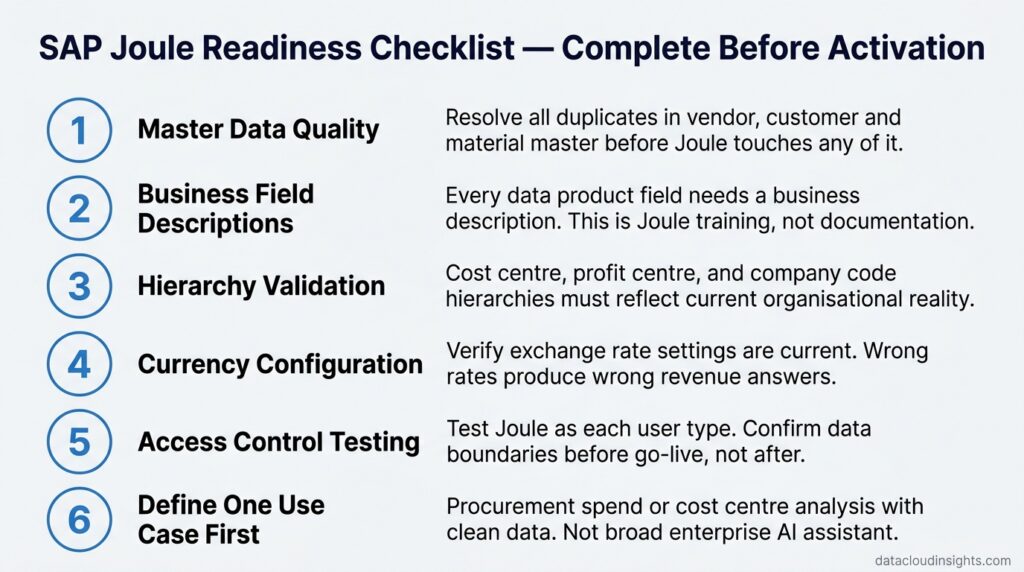
Before activating Joule on your BDC environment — work through this checklist. Every item you skip becomes a data quality incident after go-live.
Master data quality. Run a deduplication analysis on your vendor master, customer master, and material master. Any entity with more than one active record for the same real-world object needs resolution before Joule touches it. SAP MDG within BDC has the tooling for this.
Business descriptions on data product fields. Open every data product field in your Datasphere analytic models. Every field without a business description is a field Joule cannot interpret correctly. This work is time-consuming and often deprioritised. It is also the single most direct investment in Joule answer quality you can make.
Organisational hierarchy validation. Validate that your cost centre hierarchy, profit centre hierarchy, and company code structure in BDC matches the current organisational reality. Hierarchies that reflect a restructuring from 2023 and have not been updated produce wrong roll-up numbers in every Joule answer that involves organisational analysis.
Currency and exchange rate configuration. Verify that your currency conversion settings in BDC are current and correct. A Joule answer about revenue that uses outdated exchange rates is not just wrong , it is wrong in a way that is very hard to spot without deep knowledge of the underlying data.
Access control testing. Joule scenarios are designed to work with identity and source-system authorisations so users only access data and actions permitted by connected applications. That does not remove the need for testing. Teams should validate role propagation, segregation of duties, sensitive-data boundaries, logging, and exception behaviour before rollout. (Protera)
Test Joule as a regional director — confirm it shows only that director’s region data. Test as a cost centre manager — confirm it shows only that cost centre’s numbers. Test as the CFO,confirm it shows everything correctly aggregated. Security testing is the governance step that organisations most commonly skip in their excitement to go live.
What Realistic Joule Results Look Like
The organisations getting the most value from Joule on BDC in 2026 are not the ones with the most sophisticated AI agents. They are the ones who invested six to twelve months in data governance before activating Joule.
A pharmaceutical company in Germany spent eight months cleaning vendor master data, building governed procurement data products in BDC, and validating hierarchies before activating Joule for procurement analytics. After activation, Joule correctly identified the top spending categories, flagged three vendor relationships where pricing anomalies suggested renegotiation opportunities, and generated a procurement summary for the board that required zero manual verification. The procurement director used it directly.
An automotive client activated Joule three months after go-live without completing the master data governance work. Joule gave answers that looked correct but contained inconsistencies that experienced finance team members spotted immediately. Trust evaporated. The client spent another four months on the governance work they had skipped and then re-activated Joule. It worked. But the detour cost them four months and significant goodwill.
The lesson is consistent across every Joule implementation I am aware of in 2026. Governance first. AI second. Always.
Common Mistakes on Joule and BDC Projects
Activating Joule before master data governance is complete. The most common and most expensive mistake. Joule on dirty data produces wrong answers with high confidence. That combination destroys AI trust faster than almost anything else.
Skipping business descriptions on data product fields. Feels like documentation work. Is actually Joule training work. Every field without a description reduces Joule’s ability to answer questions about that domain correctly.
Treating Joule as a standalone product separate from BDC. Enterprises that skip a stage or run implementation stages in parallel without sequencing are the ones reporting stalled pilots in 2026. BDC governance and Joule activation are sequential not parallel. Governance first. (SAVIC Technologies)
Not testing access controls before go-live. A finance manager who can ask Joule questions and receives answers that include another cost centre’s confidential data is not an AI problem. It is a governance problem that AI made visible.
Expecting immediate ROI without a defined use case. Choose a process with visible friction, a measurable baseline, accessible and reliable data, manageable risk, and an engaged business owner. Procurement spend analysis with clean vendor master data is a strong first use case. Broad enterprise AI assistant without specific use case definition is not. (Protera)
Key Takeaways
- Joule is only as good as the data it queries — garbage in, confident wrong answers out
- SAP Business Data Cloud provides the governed, semantically rich data foundation that makes Joule answers trustworthy and actionable
- Master data quality is the most important prerequisite — resolve duplicates in vendor, customer, and material master before activating Joule
- Business descriptions on every data product field are not documentation — they are the semantic layer Joule uses to understand what your data means
- Joule Studio agents consume data through BDC data products — better governed data products produce more capable and trustworthy agents
- Governance first, AI second — always. The organisations getting real business value from Joule in 2026 are the ones who invested in data governance before activation
Related Reading on DataCloudInsights
- SAP BDC vs SAP Datasphere — What Is the Difference?
- SAP BDC Architecture Explained with Real Examples
- SAP BDC Data Products — Design, Governance and Engineering
- SAP BDC Governance and Security Guide
Published by the Data Cloud Insights team — SAP data professionals with hands-on BDC and Joule implementation experience across enterprise clients in Europe.


Pingback: Building an AI-Powered Finance Assistant with SAP Joule on BDC: AutoFrance SA, Part 1 - Data Cloud Insights The Business Case and Architecture SAP JOULE