
Our previous articles explored foundational data warehouse concepts and modern enterprise platforms. Building on our recent technical analyses, this comprehensive guide gathers critical SAP BDC interview questions asked during technical calls for SAP Business Data Cloud roles. Mastering these SAP BDC interview questions will help you prepare for scenario questions and clear technical rounds confidently.
Core Architecture For SAP BDC Interview
Question 1: What is SAP Business Data Cloud?
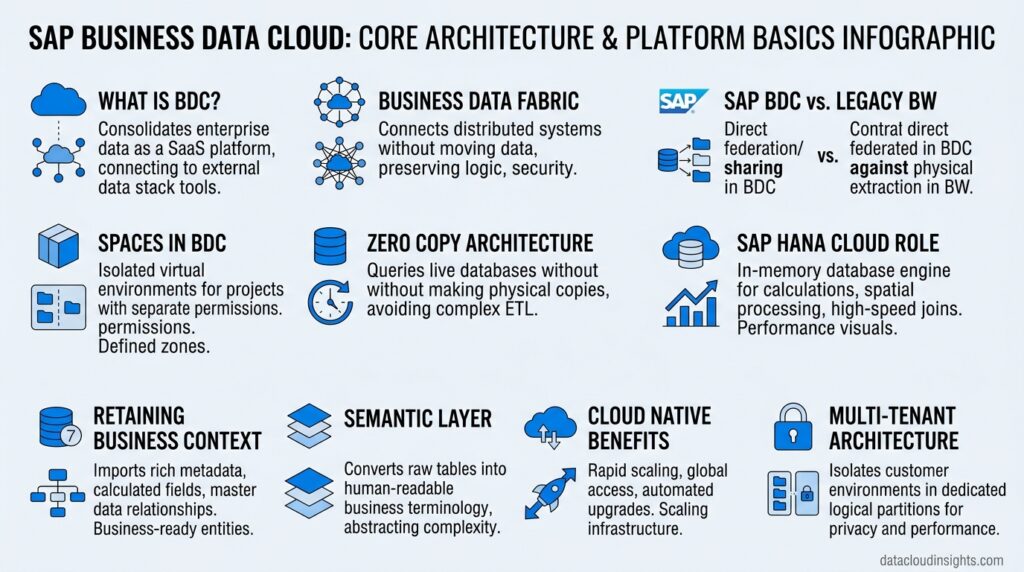
SAP Business Data Cloud consolidates enterprise data assets into a single software as a service platform. It links SAP business logic directly to external modern data stack tools. The core goal is delivering unified analytical access without stripping away critical business context.
Question 2: What is a Business Data Fabric?
A Business Data Fabric connects distributed storage systems without forcing data into one monolithic database. It preserves original data definitions, currencies, and relationships across separate systems. This architecture allows reporting tools to query records directly with security governance enforced centrally.
Question 3: How does SAP BDC differ from legacy SAP BW?
Legacy SAP BW relies heavily on physical data extraction and custom ABAP programming. SAP BDC emphasizes direct federation, open data sharing protocols, and decoupled semantic modeling. It lets teams analyze operational data where it resides without building long, fragile extraction pipelines.
Question 4: What are Spaces in SAP BDC?
Spaces are isolated virtual environments where distinct project teams build data models. They draw from shared computing pools while keeping security permissions and objects separated. This design grants individual teams full flexibility without breaking central governance rules.
Question 5: What is Zero Copy Architecture?
Zero Copy Architecture queries remote operational databases directly in place without making physical copies. It avoids complex ETL maintenance, saves storage space, and provides instant access to live transactions.
Question 6: What role does SAP HANA Cloud play inside the platform?
SAP HANA Cloud serves as the core in memory database engine. It handles complex calculations, spatial processing, and heavy analytical joins at high speeds. This engine delivers rapid query responses for active dashboards.
Question 7: How does the system retain business context from SAP S/4HANA?
The platform imports rich metadata definitions directly alongside raw database tables. It retains calculated fields, language translations, and original master data relationships. Consequently, reporting teams work directly with meaningful business entities instead of technical column names.
Question 8: What is the semantic layer?
The semantic layer sits between raw technical tables and end user reporting tools. It converts column tags into human readable business terminology like Regional Net Profit. This abstraction allows non technical analysts to build dashboards without writing database joins.
Question 9: What are the primary benefits of cloud native deployment?
Cloud native deployment offers rapid scaling, global accessibility, and automated system upgrades. Infrastructure teams can expand computing capacity instantly during quarterly financial closes. It removes the burden of managing physical server hardware.
Question 10: How does multi tenant architecture preserve operational security?
Multi tenant architecture isolates customer environments using strict software boundaries. Every enterprise processes workloads inside dedicated logical partitions. This guarantees complete data privacy and prevents resource consumption issues caused by other tenants.
Data Modeling, Integration & Sharing For SAP BDC Interview
Question 11: What is a Graphical View?
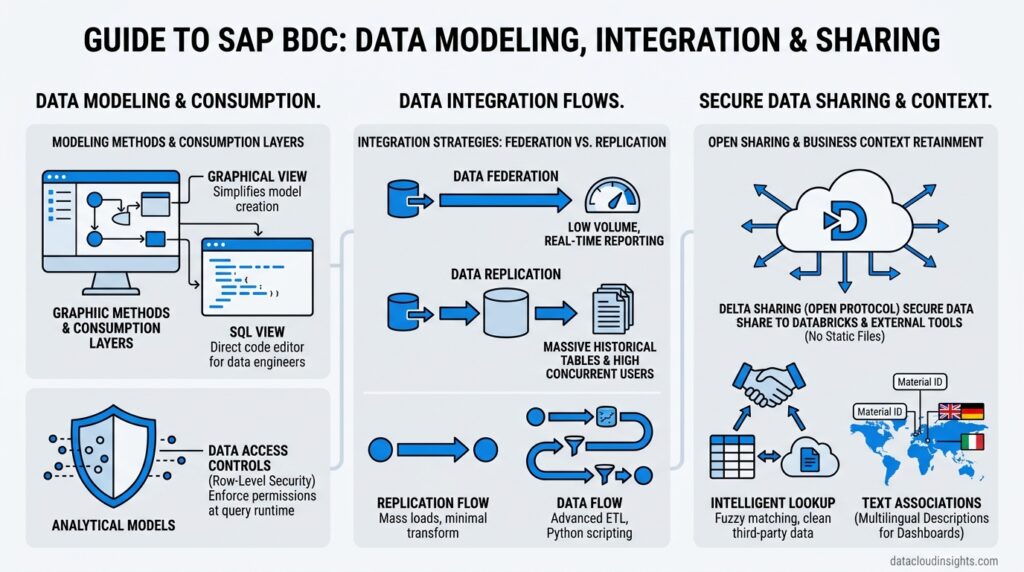
A Graphical View provides a visual drag and drop interface for building data models. Analysts drag tables onto a visual canvas to build joins, apply filters, and calculate measures. It simplifies model creation for users who prefer visual design over raw coding.
Question 12: What is an SQL View?
An SQL View offers a direct code editor for data engineers. It allows custom SQL scripts, advanced analytical functions, and precise control over complex joins. It provides maximum flexibility when building sophisticated transformation logic.
Question 13: When should you choose Data Federation over Data Replication?
Choose Data Federation for low volume, real time reporting where source systems have processing headroom. Choose Data Replication when querying massive historical tables or supporting hundreds of concurrent dashboard users to protect operational databases.
Question 14: What is a Replication Flow?
A Replication Flow is a streamlined pipeline designed to move large data volumes quickly. It copies source tables to target destinations with minimal transformation steps. It excels at mass initial data loads and automated delta tracking.
Question 15: What is a Data Flow?
A Data Flow is an advanced ETL pipeline built for multi step transformation tasks. It supports Python scripting, complex joins, data cleansing, and multi table merges. Data engineers use it when raw data requires deep refinement before reporting.
Question 16: How does Delta Sharing function inside SAP BDC?
Delta Sharing is an open protocol that shares live datasets securely across platforms. It exposes curated data models directly to external tools like Databricks without creating static files. This standard keeps remote systems synchronized cleanly.
Question 17: What are Analytical Models?
Analytical Models form the final consumption layer designed specifically for reporting engines. They organize dimensions, fact measures, calculated KPIs, and user parameters into clean star schemas. Dashboards connect directly to these curated endpoints.
Question 18: What is an Intelligent Lookup?
An Intelligent Lookup joins unstructured external files with existing enterprise master data. It uses configurable rules to match records despite missing keys or minor typos. This tool cleans third party data files before running analytics.
Question 19: Why are text associations important in dimension models?
Text associations link technical key codes to clear descriptions in multiple languages. They map material IDs to descriptive product names dynamically based on user language settings. This makes dashboards easy to navigate for global business teams.
Question 20: How do Data Access Controls operate?
Data Access Controls enforce row level security across shared data models. They evaluate logged in user credentials at query runtime to restrict visible rows. This mechanism guarantees users view only data relevant to their specific region or role.
Migration & Legacy Modernization For SAP BDC Interview
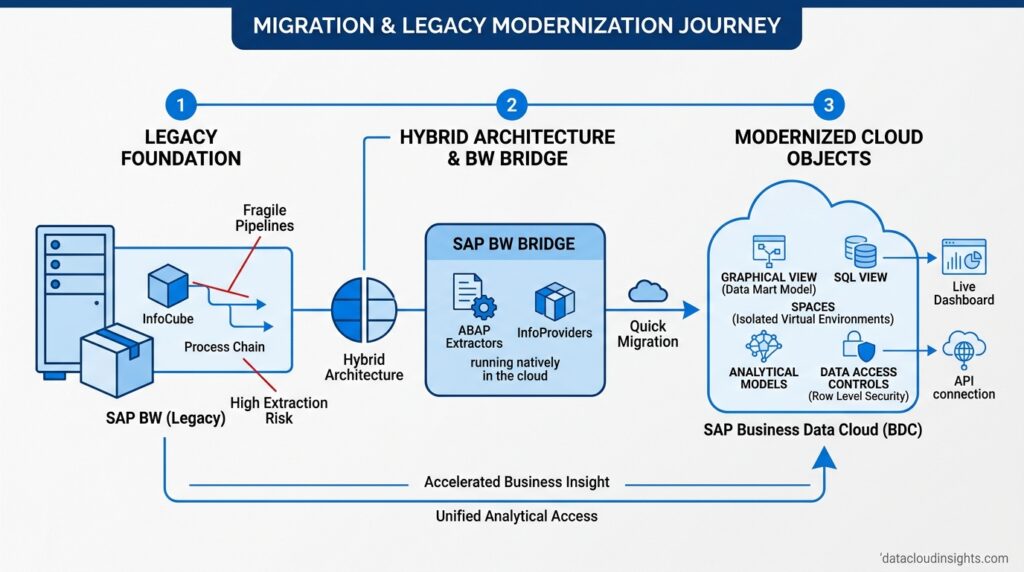
Question 21: What is the BW Bridge?
BW Bridge is an operational staging environment inside SAP BDC that hosts legacy SAP BW objects. It runs traditional ABAP extractors, InfoProviders, and logic natively in the cloud. It allows organizations to migrate quickly without re-architecting entire systems immediately.
Question 22: How do legacy InfoCubes convert into modern cloud objects?
Legacy InfoCubes convert into graphical Data Mart models or persistent cloud storage tables. Their star schema structures map cleanly into separate fact and dimension views inside Space environments. This modernizes storage while retaining historical reporting accuracy.
Question 23: What role do Core Data Services views play during migration?
Core Data Services views expose business logic and security rules directly from S/4HANA systems. Importing these views into SAP BDC preserves calculated metrics automatically. It cuts project timelines by avoiding redundant modeling work.
Question 24: Why should teams preserve staging logic during initial migrations?
Preserving existing staging logic cuts migration risk and avoids project downtime. Engineering teams move proven extraction routines directly into the cloud without disrupting business dashboards. They can optimize code gradually after initial migration succeeds.
Question 25: How do process chains transition into cloud scheduling?
Legacy process chains convert into cloud task chains or automated orchestration workflows. These tools schedule data flows, trigger delta runs, and send system alerts. They keep multi step data pipelines executing in correct order.
Question 26: What is the primary issue when moving custom ABAP code to the cloud?
Legacy ABAP code often contains outdated database calls or rigid table structures. Cloud platforms require clean code that executes efficiently on in memory engines. Teams must refactor old routines to maintain execution speed and platform stability.
Question 27: How does hybrid architecture support long term migration?
Hybrid architecture connects on premise legacy warehouses with cloud Spaces simultaneously. Organizations run legacy reporting on premise while building new analytics projects in the cloud. This approach lowers transition risks significantly.
Question 28: What are the benefits of replacing InfoObjects with Cloud Dimensions?
Cloud Dimensions simplify system administration and lower processing overhead. They eliminate rigid legacy metadata structures while providing open integration options. This transition accelerates view creation and simplifies third party integrations.
Question 29: How do you validate data consistency following a model migration?
Run parallel query scripts across legacy and cloud environments simultaneously. Compare record counts, aggregated key figures, and financial balances across historical timeframes. Identical totals confirm the migrated logic calculates metrics accurately.
Question 30: What is the ultimate goal of modernizing legacy SAP BW to SAP BDC?
The goal is building an open, scalable, real time data foundation across the enterprise. It removes system bottlenecks, cuts operational costs, and accelerates report delivery. Businesses gain clear insights that adapt rapidly to market changes.
Operations, Performance & Advanced Security For SAP BDC
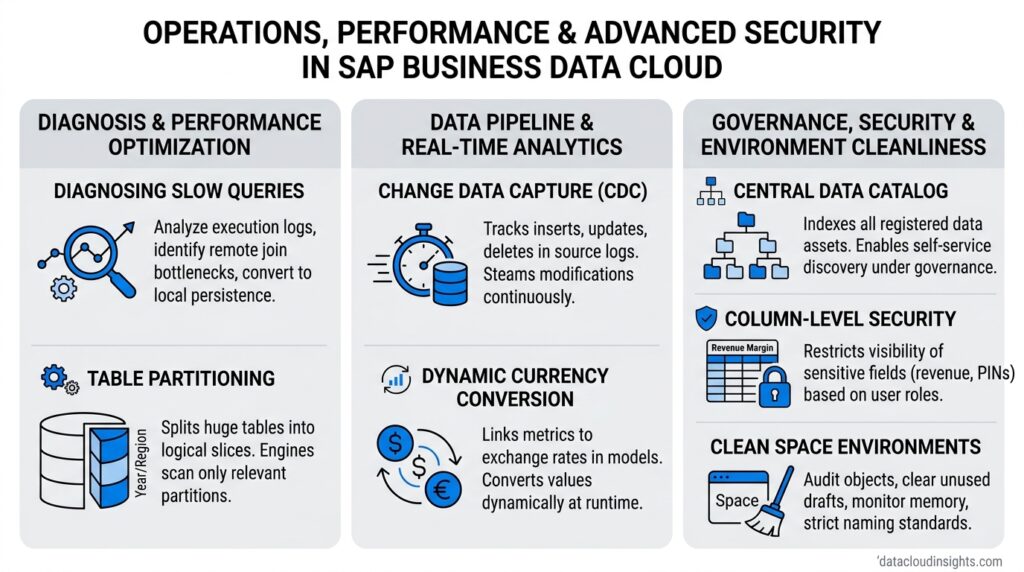
Question 31: How do you diagnose a slow running query in SAP BDC?
Analyze execution logs to spot processing bottlenecks across remote joins. If live federation overloads remote sources, convert federated objects into persistent local tables. Scheduling automated delta refreshes restores fast dashboard response times.
Question 32: Why is table partitioning critical for massive data models?
Table partitioning splits huge database tables into small, logical slices using key attributes like year or region. Query engines scan only relevant partitions instead of whole tables. This targeted approach dramatically speeds up query execution.
Question 33: How does Change Data Capture optimize data pipeline performance?
Change Data Capture tracks inserts, updates, and deletes directly inside source transaction logs. It streams modified records continuously instead of running full dataset reloads. This method lowers system overhead and reduces network congestion.
Question 34: How does dynamic Currency Conversion process inside Analytical Models?
Currency conversion links transaction metrics to central exchange rate tables directly inside Analytical Models. The engine converts values dynamically at runtime using user selected parameters. This delivers real time global financial reports seamlessly.
Question 35: What is the function of the Central Data Catalog?
The Central Data Catalog indexes all registered data assets across cloud systems. Technical teams and business analysts search for metrics, trace data origin, and review definitions easily. It drives self service discovery under central governance rules.
Question 36: How do you enforce column level security inside semantic models?
Column level security restricts visibility for sensitive fields like revenue margins or personal identification numbers. Administrators apply security policies within models to mask specific columns based on assigned user roles.
Question 37: How does memory management impact active query performance?
In memory engines process active analytical datasets directly in system RAM for maximum speed. Unoptimized joins consume excessive memory and slow down overall processing performance. Applying lean modeling practices prevents memory exhaustion and maintains quick response times.
Question 38: How do you configure automated alerts for failed pipeline tasks?
Set up automated alert rules within cloud operations dashboards. When a Data Flow or Replication Flow fails, the platform sends instant notifications to designated teams. Engineers resolve pipeline failures before business reports experience downtime.
Question 39: How do you reduce multi cloud network latency?
Deploy processing nodes in cloud regions physically closest to primary source systems. Use high speed network interconnects alongside data compression settings. These steps speed up data transfers across distributed multi cloud environments.
Question 40: What are best practices for maintaining clean Space environments?
Audit active objects regularly, clear unused draft views, and monitor memory consumption per Space. Establish strict naming standards for models, dimensions, and measures across all project teams to maintain clean organizational structures.
Scenario Questions For SAP BDC Interview
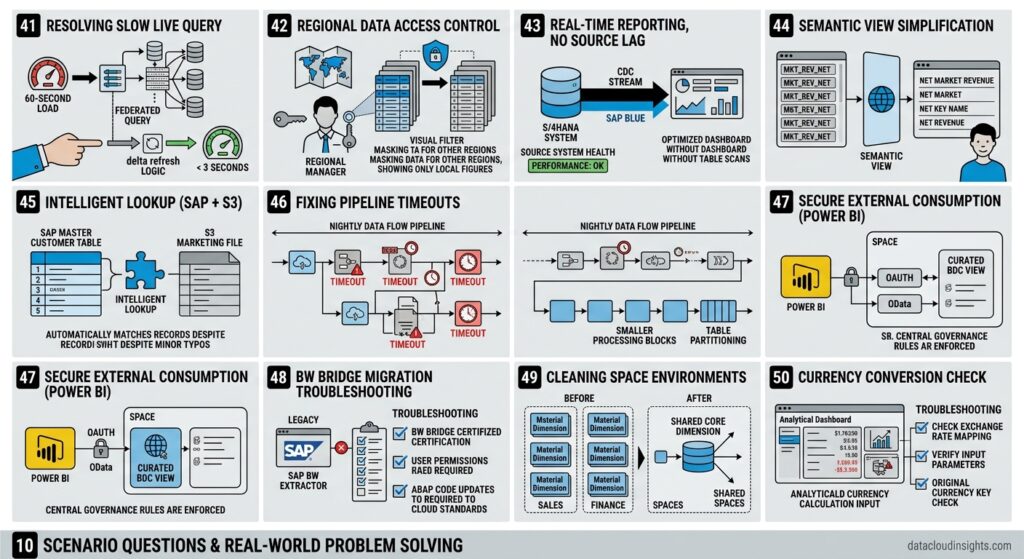
Question 41: A live federated query takes sixty seconds to load. How do you resolve this?
Analyze the query execution plan to locate remote join bottlenecks. If remote tables handle heavy transformations, move logic downstream or persist records locally using Replication Flows. Adding delta refreshes reduces load times under three seconds.
Question 42: How do you secure financial data so regional managers see only local figures?
Create a Data Access Control object mapped to user security attributes. Apply this security rule directly to the fact view inside your Space environment. The engine filters transaction records dynamically based on the logged in manager location.
Question 43: Source S/4HANA records change constantly. How do you maintain real time reporting without degrading source performance?
Implement Replication Flows utilizing Change Data Capture. This streams transactional updates into persistent target tables continuously without running heavy table scans. Dashboards read live updates without impacting source system operations.
Question 44: Business users complain technical column names are confusing. What is your fix?
Build a semantic view on top of raw database tables. Map obscure technical column tags to human readable business names like Total Gross Revenue. Expose this curated layer to dashboard builders instead of raw tables.
Question 45: You must join SAP customer master records with an external S3 marketing file. How do you design this?
Import SAP master tables into your Space alongside S3 file endpoints. Use an Intelligent Lookup object to match customer records despite minor formatting variations. Build a Graphical View combining both sources into a single analytical endpoint.
Question 46: A nightly Data Flow pipeline keeps timing out. What steps do you take?
Review pipeline logs to locate memory heavy transformations or unindexed joins. Break large multi step flows into smaller, sequential processing blocks. Introduce table partitioning on source tables to speed up read operations.
Question 47: You need to expose cloud analytical models to Power BI securely. How do you configure this?
Enable open consumption interfaces on the Analytical Model. Configure OAuth authentication protocols within tenant administration settings. Connect Power BI using native cloud connectors to query curated views directly under central security policies.
Question 48: During migration, legacy BW extractors fail to run in the cloud. How do you troubleshoot?
Check if target extractors are certified for BW Bridge compatibility. Verify user authorization profiles and system communications within cloud connection settings. Update non compliant ABAP code routines to meet modern cloud standards.
Question 49: Multiple development teams create duplicate dimension models in different Spaces. How do you clean this up?
Establish a shared core Space managed by central governance lead architects. Build standardized dimension models once within this shared space and share them outward. Individual department teams consume central views without rebuilding duplicate assets.
Question 50: An executive dashboard shows wrong currency calculations. How do you resolve this?
Open the Analytical Model and check exchange rate table mappings. Verify whether target currency parameters pull live inputs from report filters correctly. Ensure source transaction records include proper original currency keys before processing conversions.
Common Mistakes to Avoid in SAP BDC Projects
- Over federating complex queries: Relying exclusively on live federation for high volume joins causes severe performance degradation on source systems.
- Ignoring semantic modeling standards: Exposing raw technical column names directly to business users creates confusion and ruins self service reporting goals.
- Neglecting partition strategies: Failing to configure table partitioning on persistent datasets leads to slow analytical queries as storage grows.
Key Takeaways
- Shift technical mindsets from traditional physical extraction pipelines toward flexible, real time semantic modeling.
- Evaluate performance trade offs carefully between data federation latency and local storage replication costs.
- Ground technical interview answers in practical implementation experience rather than repeating vendor slides.
Related Reading on Data Cloud Insights
- SAP BDC Architecture Explained
- SAP Analytics Cloud Complete Guide
- SAP BDC Certification Guide C_BCBDC
- SAP Analytics Cloud vs Power BI
- SAP BDC for Data Engineers Series
- SAP Analytics Cloud for Data Engineers Series
Stay tuned for our upcoming installment covering live hands on coding challenges and real world scenario tests used by top enterprise recruiters.