
You have spent years building data pipelines. You know Azure Data Factory, Apache Spark, Delta Lake, dbt, and probably have strong opinions about medallion architecture. You can write PySpark in your sleep and you have been in enough data quality incidents to know exactly why governance matters.
Then someone in a meeting says SAP Business Data Cloud and the room nods like it is obvious.You nod too. Then you Google it on your phone under the table.
This post is the result of that Google search written by someone who has been on both sides of that table. A data engineer who moved into the SAP analytics world and spent a significant amount of time figuring out how BDC maps to everything they already knew.
SAP Business Data Cloud is more familiar than it sounds. The concepts translate. The terminology is different. The scale of the problem it is solving is genuinely impressive. And for data engineers specifically, BDC is emerging as one of the most important architecture conversations in enterprise data right now, which means understanding it is quickly becoming a career advantage rather than just a curiosity. (SAVIC Technologies)
Let us go through it properly.
What is SAP Business Data Cloud : the honest explanation
SAP Business Data Cloud was announced in February 2025. In 2026 it is no longer just an announcement. Companies are actively building on it and the platform is expanding fast.(Crave Infotech)
Large enterprises running SAP and there are thousands of them across every industry have always had a data problem. Their most valuable business data lives in SAP systems. Financial transactions in S/4HANA. Procurement data in Ariba. HR data in SuccessFactors. Supply chain data in IBP. Each system is excellent at what it does. None of them talk to each other easily.
When these companies want to build analytics, AI models, or integrated reporting across all of that data they have historically had to extract it, move it somewhere, clean it, try to maintain the business context that got lost during extraction, and then build on top. An expensive, slow, fragile process that every data engineer who has worked with SAP data knows intimately.
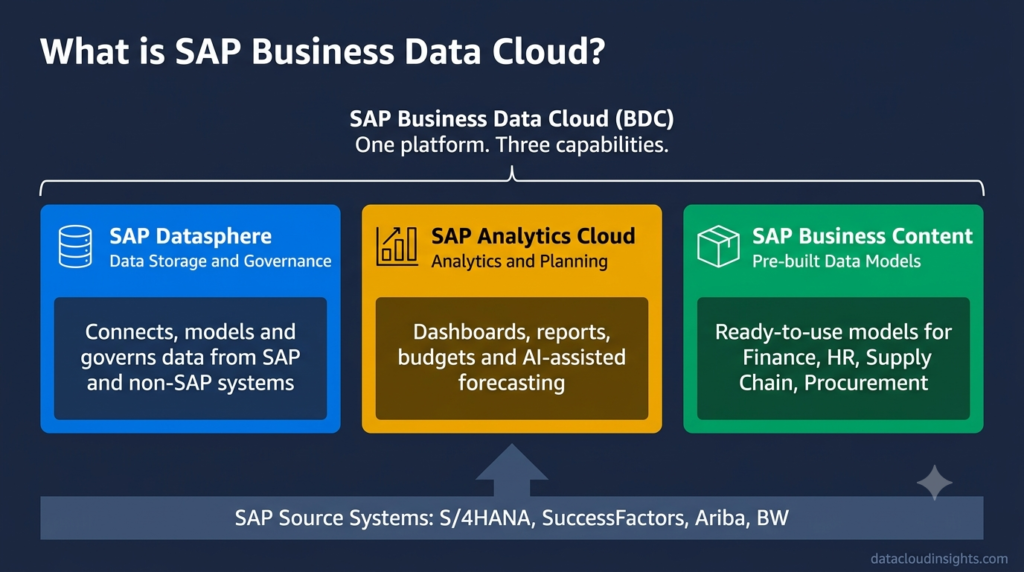
SAP Business Data Cloud pulls three things that used to be separate into one place. SAP Datasphere is where your data is stored, organised, and governed connecting data from SAP and non-SAP systems while keeping it consistent. SAP Analytics Cloud is where you build reports, dashboards, and plans how business users actually see and use the data. SAP Business Content is a library of ready-to-use data models and reports for common business areas including finance, procurement, supply chain, and HR. (Crave Infotech)
That is the platform at the highest level. Now let us go deeper on what each layer actually means for a data engineer.
Why SAP built BDC : the problem it is actually solving
To understand BDC properly you need to understand the specific pain it is addressing. Because it is not a generic data platform. It is a solution to a very specific enterprise problem.
Many organisations already have SAP Datasphere, SAP Analytics Cloud, BW, and third-party data platforms in play. Business Data Cloud matters because it reframes the data layer around connected business semantics not just raw integration or dashboarding. (SAVIC Technologies)
That phrase connected business semantics is the key to understanding what makes BDC different from a standard data platform.
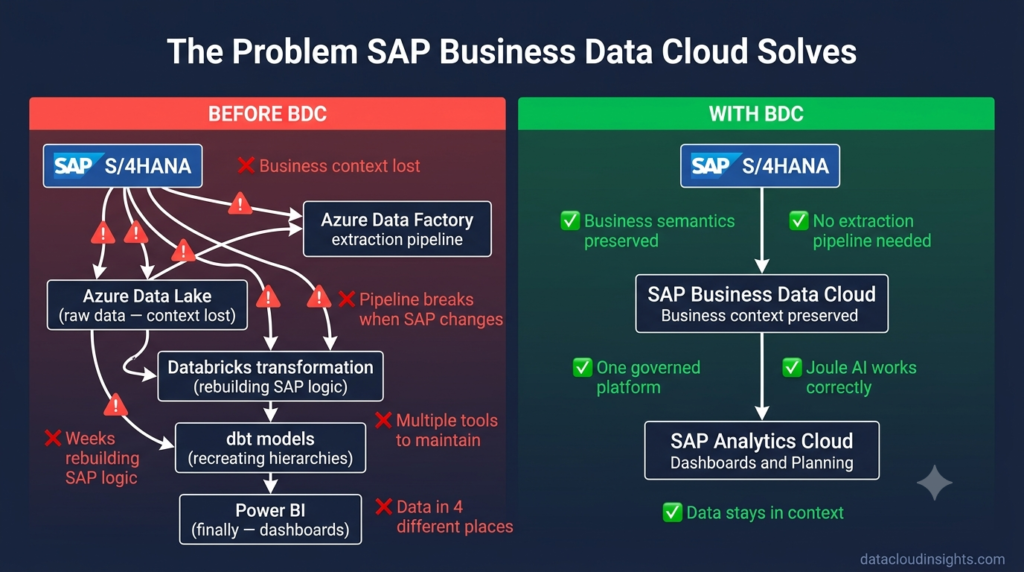
When you extract financial data from S/4HANA into a Delta Lake table, you get numbers. Revenue figures. Cost amounts. Transaction counts. But you lose the context that makes those numbers meaningful in an SAP environment. The company code hierarchy. The profit centre structure. The cost centre allocations. The currency conversion logic. The fiscal year variant. The intercompany elimination rules.
All of that context built into SAP over decades disappears the moment the data leaves the SAP system. Then you spend months rebuilding it in dbt models, Databricks notebooks, and custom transformation logic. And every time SAP’s organisational structure changes, your pipeline breaks.
BDC is SAP’s answer to this problem. Keep the data connected to its source business context. Let the analytics and AI tools consume it in place rather than extracting and losing the semantics. The data stays in SAP’s governed layer. The tools come to the data rather than the data going to the tools.
For a data engineer this is either a relief or a threat depending on your perspective. A relief because it eliminates a significant amount of painful extraction and reconstruction work. A threat if your entire value proposition on a project was building that extraction and reconstruction infrastructure.
The honest assessment BDC does not eliminate data engineering work. It changes what data engineering work looks like in an SAP environment. More governance design, more data product thinking, more focus on semantic layers and less on raw pipeline plumbing.
The BDC architecture : mapped to concepts you already know
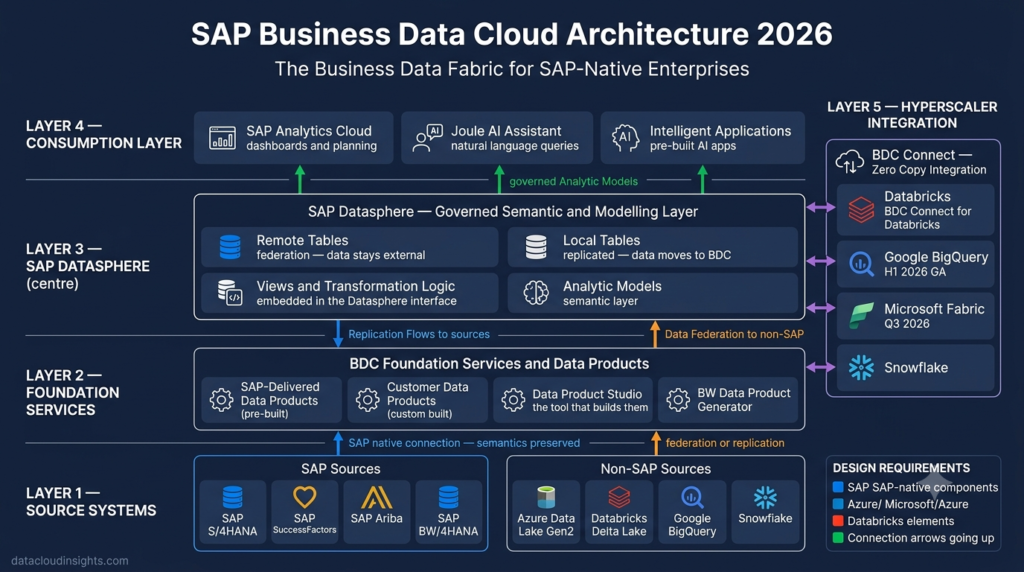
The unifying layer is the BDC Data Product Studio a central hub where data architects define, govern, and publish data products that can be consumed by Joule’s AI agents, SAC planning models, and third-party BI tools alike. (SAVIC Technologies)
Let us map the BDC architecture to the data engineering concepts you already know.
SAP Datasphere : governed data layer
If you come from a lakehouse architecture background, Datasphere is the closest thing SAP has to a governed lakehouse. It is where data from SAP source systems S/4HANA, BW, SuccessFactors, Ariba lands, gets modelled, and gets governed before being consumed by analytics tools.
In a Databricks context, Datasphere is the combination of Delta Lake plus Unity Catalog plus dbt a governed storage and modelling layer with built-in lineage, access control, and semantic definitions. The difference is that Datasphere understands SAP’s business semantics natively. It knows what a profit centre is. It knows what a fiscal year variant means. It knows how cost centre hierarchies work. You do not have to teach it.
The tables in Datasphere are not raw tables. They are governed analytical models with business logic embedded dimensions, hierarchies, currency conversions, and calculated measures defined once and available to every consuming application. The equivalent of a well-designed dbt semantic layer but native to the SAP ecosystem.
SAP Analytics Cloud : consumption layer
SAC sits on top of Datasphere as the primary consumption layer for business users. Dashboards, planning models, AI-assisted forecasting all consuming from the governed Datasphere layer underneath.
In Azure terms, SAC is the equivalent of Power BI sitting on top of an Azure Synapse Analytics semantic model. The difference is that SAC and Datasphere are designed by the same vendor to work together natively the integration is not a connector you configure but an architectural design decision.
SAP Business Content : accelerator library
SAP Business Content is SAP’s curated library of pre-built data models, KPIs, and analytics content for finance, supply chain, HR, and procurement arriving pre-wired to BDC’s governed data layer and dramatically reducing time to insight. (SAVIC Technologies)
In data engineering terms, Business Content is the equivalent of a library of pre-built dbt packages and Databricks notebooks for SAP data. Instead of writing transformation logic for General Ledger data from scratch SAP ships you a pre-built model that already knows the structure of GL data in S/4HANA and exposes it correctly for analytics consumption.
The practical impact implementations that previously required six months of custom data modelling work can now start from pre-built content and spend that six months on business-specific customisation instead.
BDC and Databricks : the partnership that changes everything
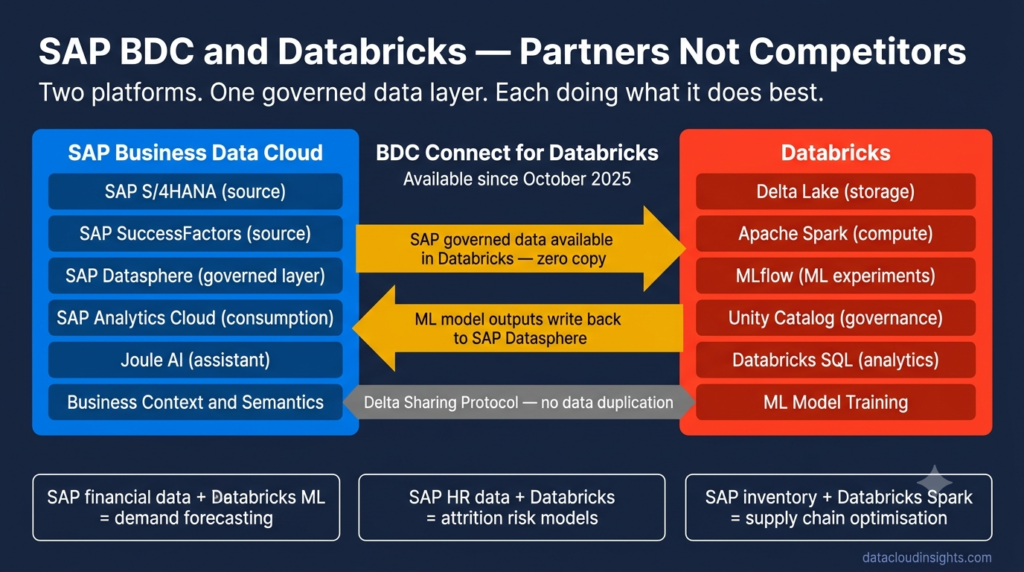
This is the part that most data engineers do not know about yet and it is arguably the most important development in the BDC story for people with a Databricks background.
BDC Connect for Databricks has been available since October 2025. Integrations for Google BigQuery and Snowflake are scheduled for the first half of 2026, with Microsoft Fabric planned for the third quarter. These integrations aim to minimise data movement and should enable consistent analytics execution across different platforms. (BARC)
SAP and Databricks announced a strategic partnership that goes significantly deeper than a standard connector. The integration called BDC Connect for Databricks allows organisations to run analytical workloads on SAP BDC data using Databricks compute, without extracting the data from BDC’s governed layer.
For a data engineer this is significant. It means:
You do not have to choose between the SAP data governance model and the Databricks compute model. You can use both simultaneously. SAP governs the data, manages the business semantics, handles the SAP-specific context. Databricks provides the compute for complex transformations, machine learning model training, and large-scale data processing.
SAP Databricks is now positioned as a component within the BDC licensing model with Databricks Units (DBU) as the normalised unit of processing power for SAP Databricks Capacity Services. (FitGap)
This means a data engineer with Databricks skills working on a BDC project is not learning a completely foreign platform. They are extending their existing skills into a new governance context. The Spark jobs they already know how to write still run. The Delta Lake tables they already know how to optimise still exist. The Unity Catalog governance concepts they already understand map directly to concepts in BDC.
The architecture that is emerging on enterprise BDC projects in 2026 looks like this:
SAP source systems (S/4HANA, SuccessFactors, Ariba) feed data into SAP Datasphere where SAP’s business semantics are preserved and governed. For complex analytical workloads requiring Spark-scale compute data is accessed by Databricks through BDC Connect without extraction. The results flow back into Datasphere or directly into SAC. Business users consume everything through SAC without ever knowing what is happening underneath.
Two platforms. One governed data layer. Each tool doing what it does best.
BDC vs your current Azure and Databricks stack the honest comparison
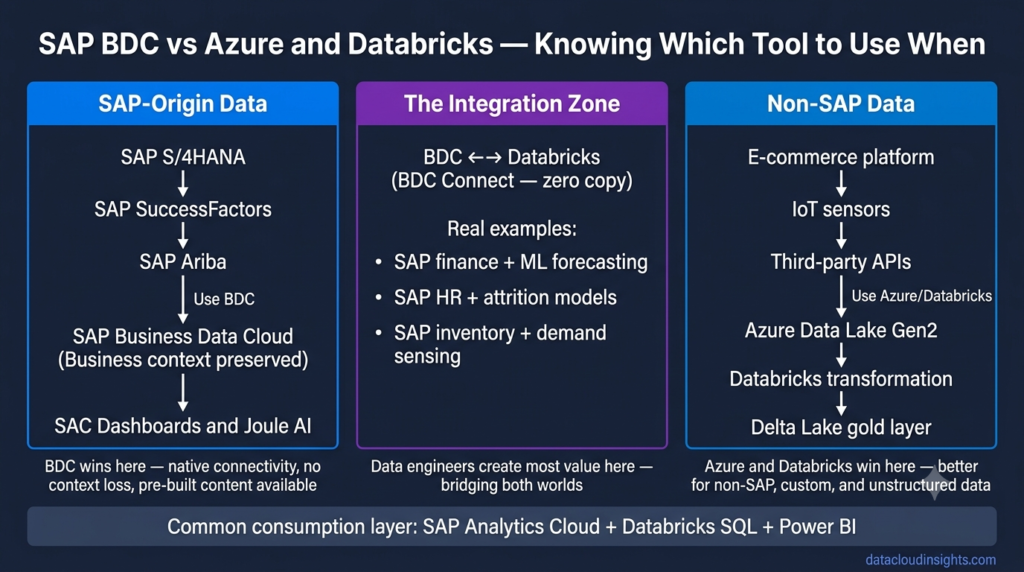
This is the question every data engineer asks when they first encounter BDC on a project. Do we replace our current stack with BDC? Do we run them in parallel? Does BDC make what we already built redundant?
The honest answer depends on your starting point.
If your organisation has an existing mature Azure data platform (Azure Data Lake Storage Gen2, Azure Data Factory pipelines), Databricks transformation layer, Delta Lake gold tables, Power BI on top BDC does not replace that stack. It sits alongside it for the SAP-specific data workloads where preserving business semantics is critical.
Think of it as two specialised tools rather than one replacing the other. Your Azure Databricks stack handles the non-SAP data e-commerce transactions, IoT data, third-party feeds, social data, any data that does not originate in SAP systems. BDC handles the SAP data (financial, procurement, supply chain, HR) where the business context that SAP embeds is valuable enough to preserve rather than lose through extraction.
The integration point between the two worlds is where data engineers create the most value on BDC projects. Joining SAP financial data from BDC with customer behaviour data from a Databricks gold layer. Feeding machine learning models trained in Databricks with governed feature data from BDC Datasphere. Publishing Databricks ML model outputs back into SAC for business user consumption.
If your organization is starting its data platform journey without an existing modern stack BDC is a genuinely strong starting point specifically for SAP-heavy enterprises. The pre-built content, the native SAP connectivity, and the governed data layer give you a head start that would take years to replicate on a custom Azure stack.
BDC is deeply integrated across SAP applications so your most critical data retains its original business context and semantics and the hidden costs of data extracts are eliminated. (SAVIC Technologies)
That last point is worth quantifying on your specific project. Add up the engineering time spent extracting SAP data, rebuilding business context in transformation code, maintaining those extractions when SAP’s organisational structure changes, and debugging data quality issues caused by context loss during extraction. On most large SAP implementations that is a significant number. BDC eliminates most of it.
BDC and AI : why this platform exists in 2026 specifically
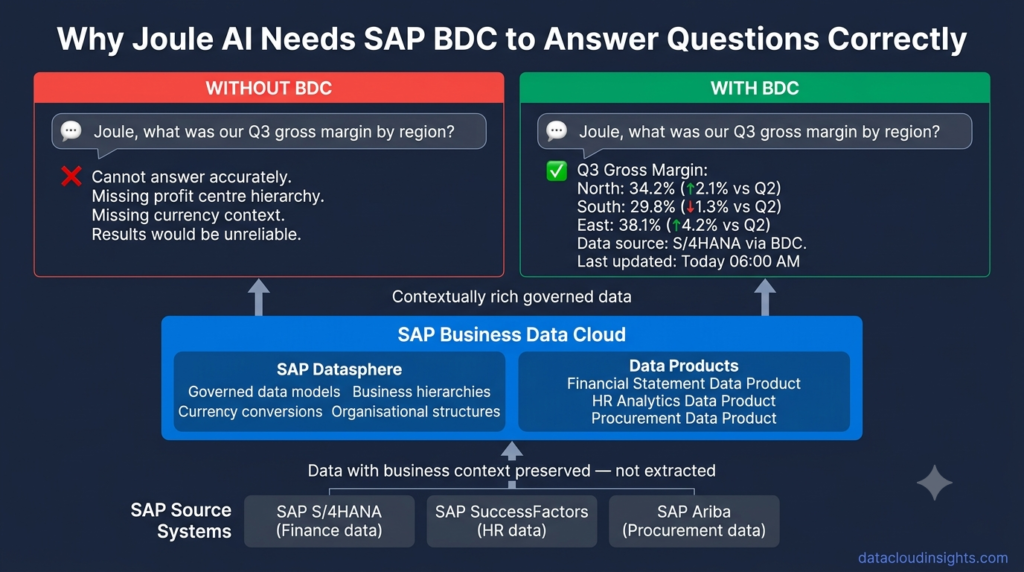
You cannot have a technology conversation in 2026 without discussing AI. BDC is no exception and understanding why AI is central to the BDC story explains why SAP built it now rather than five years ago.
AI and analytics need better business context, and disconnected data estates make that nearly impossible at scale. BDC is especially relevant for companies trying to make Joule and SAP Business AI more useful in day-to-day decisions. (SAVIC Technologies)
Joule is SAP’s AI assistant embedded across SAP applications to help business users complete tasks using natural language. Ask Joule to summarise last quarter’s financial performance. Ask it to identify which suppliers are at risk of delivery delays. Ask it to model the impact of a 10 percent headcount reduction on operating costs.
For Joule to answer these questions accurately it needs high quality, well-governed, contextually rich data. Data that knows what a profit centre is. Data that understands the relationship between a purchase order and an invoice and a payment. Data that maintains currency context and organisational hierarchy.
That is exactly what BDC provides. BDC is the data foundation that makes enterprise AI actually work in an SAP environment. Without it Joule is answering questions with incomplete, decontextualised data and producing answers that sound plausible but are technically wrong.
For data engineers the practical implication if your company is investing in SAP AI capabilities, BDC is not optional infrastructure. It is the prerequisite. Building AI on top of extracted, decontextualised SAP data is building on sand. Building AI on top of BDC’s governed semantic layer is building on concrete.
What BDC means for your career as a data engineer
With SAP Sapphire 2026 in May, BDC is the headline infrastructure story of the year and organisations that wait to start planning will already be behind. (SAVIC Technologies)
The data engineer who understands both the modern cloud data stack and SAP BDC is genuinely rare right now. Most SAP consultants do not have deep cloud data engineering backgrounds. Most data engineers do not understand SAP’s data model and business semantics.
The people who sit in the middle who can design the architecture that connects an Azure Databricks lakehouse to SAP BDC, who can speak the language of both worlds, who can bridge the SAP consulting team and the data engineering team those people are in very high demand on enterprise BDC projects in 2026 and that demand is accelerating.
If you have been working with Azure, Databricks, and modern data stacks and you are now reading about BDC because it has appeared on a project or in a job description you are not starting from zero. You are starting from a significant advantage that you just need to translate into the SAP context.
That translation is what this series is about.
What is coming in Part 2
Part 1 gave you the landscape what BDC is, why it exists, how it maps to concepts you already know, and why it matters for your career.
Part 2 goes into the architecture in depth. The actual layers, the data flow, how Datasphere’s modelling concepts map to lakehouse architecture, what a Data Product means in BDC and how it differs from a dbt model, and the specific technical decisions that determine whether a BDC implementation succeeds or struggles.
Subscribe below to get notified when Part 2 publishes.
Related reading on Data Cloud Insights
- SAP BDC Architecture Explained with Real Examples
- SAP Analytics Cloud Complete Beginner’s Guide
- SAP Analytics Cloud vs Power BI — Honest Comparison
- SAP Analytics Cloud for Data Engineers — Part 1
Published by the Data Cloud Insights team — SAP data professionals with hands-on implementation experience across Europe, bridging modern cloud data engineering and the SAP analytics ecosystem.

Pingback: SAP Business Data Cloud and Databricks: Integration Guide for Data Engineers 2026 (Part 3)
Pingback: SAP Business Data Cloud Data Products: Design, Governance and Engineering Decisions (Part 4)
Pingback: SAP Business Data Cloud and Azure: The Complete Integration Guide for Data Engineers 2026 (Part 5)
Pingback: SAP BDC vs Your Current Stack: Honest Migration Guide for Data Engineers 2026 (Part 6)
Pingback: SAP Business Data Cloud Governance and Security: A Data Engineer's Guide 2026 (Part 7)
Pingback: SAP Business Data Cloud Certification Guide: How to Pass C_BCBDC in 2026 (Part 8)
Pingback: SAP BDC Interview Questions: 50 Questions Guide
Pingback: Ingesting SAP BDC Data into Databricks Delta Lake Pipeline
Pingback: 40 SAP Analytics Cloud Terms Every Beginner Must Know (2026)
Pingback: SAP BDC vs SAP Datasphere: What Is the Difference? (2026) - Data Cloud Insights
Pingback: SAP BDC vs SAP Datasphere: What Is the Difference? (2026)